How we picked
1. It has to match WOLF on a stated strength, or undercut it
That is the entry rule and it is deliberately narrow. Every pick below either publishes something WOLF publishes — a quiet motor, both rotation directions, per-watch settings — or does the core job for materially less money. Nothing is here because it looks like a WOLF.
2. A published turns-per-day figure beats a mode number
This is the single most useful filter in the whole category, and it is where the price ladder stops making sense. Of the six picks, three publish real numbers or ranges: the Rothwell states five TPD speeds up to 1,950 and three directions set per watch, the Barrington states an adjustable TPD range with clockwise, counter-clockwise and both, and the Versa states twelve programs covering the common bands and all three directions. A winder that lists “mode 1–5” leaves you guessing whether your movement is getting 650 turns or 2,400. Our guide to TPD settings explains how to find the right number for a given caliber, and our adjustable-TPD roundup filters the registry on exactly this.
3. Direction, and the trap in the word “bi-directional”
Here is the finding that matters most on this page, and it comes from reading two makers’ own words side by side. WOLF and Barrington define bi-directional in opposite ways. WOLF’s listing for the Cub states 900 TPD doublingwhen you run it bi-directional — so you get 1,800 turns split between the two directions. Barrington’s bi-directional setting splits the turns you have selected between the two directions instead. Same word, opposite arithmetic. If you set a winder by the number on the box and never check which convention it uses, you can be out by a factor of two. Our guide to which direction a winder should turn carries that comparison in full.
4. Power, because a winder has to live somewhere
WOLF publishes no power source for the Cub. Four of these six publish one, and two of them — the Barrington and the Rothwell — run on AA batteries as well as mains. That is not a trivial feature: a battery-capable winder can sit inside a safe or a wardrobe where there is no socket, which is where a lot of people actually want to keep a watch worth winding. See our battery-powered roundup and what a winder costs to run.
Which alternative, for which buyer
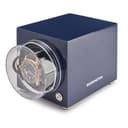
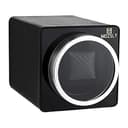
One watch, sensible money: the Versa Single Elite. Twelve programs is the number that matters — enough to cover the common TPD bands and all three directions, which is the entire job. A quiet Japanese motor and mains-or-battery power on top. It is the pick we would put in most houses, and our single-winder roundup ranks it against the rest of the category.
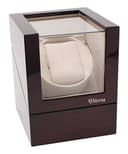
One watch, and you want to set exact numbers: the Barrington Single. It costs more than the WOLF Cub, and it is on this page anyway, because it publishes the thing WOLF does not: a full adjustable TPD range plus direction choice, so you can match the winder to the movement instead of hoping a pre-set is close enough. It also stacks with matching modules rather than being replaced when the collection grows — the same logic behind WOLF’s six-sided case.
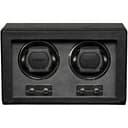
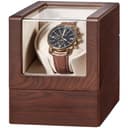
Two watches: the Rothwell Double, which is the widest settings range in our registry: five TPD speeds to 1,950, three directions, each position set independently, and two separate quiet motors rather than one motor driving both positions. Compare it to buying two WOLF singles and the arithmetic is not close. Our double-winder roundup and single vs double work through whether you need the second position at all.
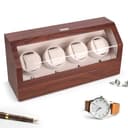
Four watches: the Heiden Quad, which makes one claim nothing else here makes and WOLF does not make either: Heiden’s listing states a no-magnets construction. Magnet exposure is the one genuine mechanical risk in a winder and it comes from the motor rather than the rotation, so a maker that addresses it is answering a real question. Our multi-watch roundup covers four, six and eight positions, and how to demagnetize a watch explains what happens when a movement does get magnetised.
Under $100: the MOZSLY Single, with twelve rotation modes and a quiet motor for under a hundred dollars. The honest truth about this category is that past a competent quiet motor and adjustable TPD, you are paying for materials and a badge — which is exactly what our under-$100 page is about.
As little as possible: the BEWISHOME Single at under $30. Mains or battery, multiple rotation modes, and a maker that keeps its listings alive across years, which matters if you want a matching second unit later. It publishes no TPD figure — almost nothing under $50 does, as our sub-$50 roundup found — so set it to its lowest program and check the watch over a week.
What you give up by not buying the WOLF
Three things, and they are real.
The cuff. WOLF’s patented lock-in dynamic cuff, adjustable to three wrist sizes, is the best-documented holder in the category and the part of a winder that touches your bracelet every day. Nothing on this page publishes an equivalent mechanism. If you own one watch on a bracelet you care about, that is a legitimate reason to pay WOLF’s price — and our winder-with-storage page cards the WOLF Heritage single for exactly that reason.
Counted turns. WOLF counts rotations rather than estimating them from a timer. Most of the alternatives here almost certainly run a timed program; the difference will not damage a watch either way — a healthy automatic’s mainspring slips once it is full, which is why overwinding by a winder is mechanically impossible — but it does mean a counted program delivers what it says it delivers.
Materials and resale. A WOLF is built to be kept and holds some value. A $30 winder is a consumable. Both are reasonable purchases; they are not the same purchase. If the question underneath all this is whether you need a winder at all, read is a watch winder worth it first — for a lot of collections the answer is a watch box and a Sunday afternoon.