What each maker publishes
These are the two companies’ own figures, not ours. Note how little overlap there is — they do not even publish the same categories of information:
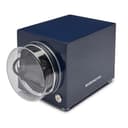
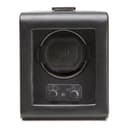
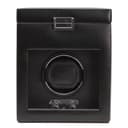
- Turns per day.WOLF: one fixed figure, 900 TPD, becoming 1,800 if you select bi-directional. Barrington: five selectable steps — 650, 750, 850, 1,000 and 1,950.
- Direction. Both offer clockwise, counter-clockwise and bi-directional. Barrington states explicitly that bi-directional splits the same total between the two directions rather than doubling it.
- Noise.Barrington calls it an “ultra-quiet Japanese motor”. WOLF publishes no noise figure and makes no quiet-motor claim for the Heritage line anywhere on the page — which is why the spec table above reads “Not published” rather than “No”.
- Holding the watch.WOLF’s patented lock-in cuff is rated for cases up to 52mm. Barrington offers two cushion sizes by strap circumference — Omni for 16.5–22cm, which Barrington says suits 85% of customers, and Micro for 12.5–16.5cm.
- Power.WOLF: included AC adapter, or D-cell / lithium cells. Barrington: AC mains over USB Type-C, or 4 x AA with an approximate 60–70 day life and a low-battery LED.
- Warranty.WOLF: five years. Barrington: two years, plus a stated out-of-warranty repair service and a claim that the winders are “built to allow easy access for repair”.
- Growing the setup.Barrington’s “Jump” feature links several winders to one power source over a supplied cable. WOLF’s answer is to buy the module size you need up front.
One caveat we would rather state than hide: Barrington publishes those TPD steps on its ownsite for its Oxford single. The Amazon listing we link to does not reprint them, which is why the comparison table above carries “Not published” in the turns-per-day column for the Barrington. We do not copy a figure from one page onto a different listing.
Why WOLF costs what it costs
It is not the winding. A 900-turn program is an entirely ordinary amount of rotation — most automatics are happy somewhere between 650 and 900 turns a day, as our TPD settings guide sets out. What you are paying for is the cuff, the case and the warranty.
The cuff is the part worth taking seriously. The most common real-world complaint about winders has nothing to do with movements: it is a watch that sits badly, or a bracelet stretched over a cushion that is too large for it. A cuff rated to 52mm that locks in place is a genuine engineering answer to that, and it is the reason WOLF is the sensible pick for a heavy diver on a steel bracelet. The five-year warranty is the other half of the argument — a winder is a small motor running for years, and who stands behind it matters.
What you are notgetting is control. One fixed turn count means you cannot dial the winder down for a movement that wants less, and WOLF’s program is intermittent by design, with pause and sleep phases pre-programmed and a ten-second start delay. That is a deliberate choice, and a defensible one — a winder should not be turning continuously — but it is a program you accept rather than set.
Why Barrington is the enthusiast pick
Five TPD steps and three directions is a settings grid that covers essentially every movement an ordinary collection contains, which means you can match the winder to the watch rather than hoping a pre-set is close enough. Add the explicit quiet-motor claim and the AA-battery option — 60 to 70 days a set, on Barrington’s own figure — and you have a winder that can live in a bedroom or inside a cupboard without a socket.
The “Jump” cable is the underrated feature. Collections grow, and the normal failure mode is a dresser with three winders and three wall warts on it. Linking modules to one supply is a tidier answer than replacing the winder with a bigger one.
The honest marks against it: two years of warranty rather than five, and a deliberately understated case. If you wanted the winder to be an object on display, this is not the one.
Who should buy which
- One large, heavy automatic you care about— WOLF. The cuff and the warranty are the argument, and a 42–45mm diver on a steel bracelet is exactly the case that defeats a generic cushion.
- A movement with a specific appetite, or a bedroom— Barrington. Published, selectable turns per day and a stated quiet motor.
- One watch rotating, several resting— the WOLF Heritage with storage. One powered position and fabric-lined storage for the rest, which is the shape most collections actually are.
- Two watches — neither, yet. Our double-winder roundup covers the question that actually decides a two-position winder: whether each position gets its own program.
- You want 90% of this for a fifth of the money— the Versa Single Elite. Twelve rotation programs and a quiet Japanese motor. What you give up is the cuff, the materials and the warranty — and our WOLF versus Versa comparison takes that trade apart in detail.
The thing both brands are bad at
Neither maker will tell you whether you need a winder at all, and most people asking this question do not. A winder earns its place for a watch you rotate but wear often enough that resetting it is a chore — a day-date, an annual calendar, a GMT you travel with. For one automatic that you wear most days, the winder solves nothing that your wrist was not already solving. Before you spend $400 on either of these, read do automatic watches need a winder and is a watch winder worth it. We would rather lose the sale than have you buy furniture for a problem you do not have.