How we picked
1. A dress watch, judged as a dress watch
That means a slim, uncluttered case meant to sit under a cuff, a legible dial without a dive bezel on it, and proportions on the smaller side of modern. It does not mean a sports watch on a leather strap. Every pick here is 36 mm to 42 mm, and six of the seven publish a diameter — the one that does not is the Esteem II, for which Orient publishes no sheet at all. If size is the thing you are least sure about, read our size guide first — the lug-to-lug figure matters more than the diameter, and only one watch on this page publishes it.
2. A live price under $300, checked rather than assumed
The cap is enforced against the live price layer on the date printed beneath the comparison table, not against a list price or a sale we remember. The band runs from about $200 to about $280 here, which means one pick doubles as the budget option for the band below — our dress automatics under $200 page covers that cheaper band in full, and the honest summary of it is that below $200 the household names disappear completely.
3. Then who made the movement, and whether they will name it
Three of the seven name an actual caliber: the small-seconds Bambino (Orient F6222) and the two Miyota 9015 micro-brands. The others do not. Timex states “21-jewel automatic” and declines to say whose; Bulova’s own page for the Surveyor says “Automatic” and stops — no caliber, no jewel count, no power reserve; and the two remaining Orient listings describe the movement only as an Orient automatic with hand-winding.
A name is worth having for one reason: it carries figures. Because Miyota publishes a specification for the 9015, a $200 TOPHILL inherits a stated accuracy band, a stated beat rate and a stated reserve. Because Orient publishes a sheet for the F6222, the Bambino inherits the same. Nothing else here has numbers attached, which is why our accuracy guide matters more on this page than on most: with no published band, there is no figure to hold the watch to.
4. And then the crystal, read as a material rather than a word
Two picks state sapphire. Two state mineral. One states acrylic. Two publish nothing. On the Mohs hardness scale, the corundum that synthetic sapphire is grown from sits at 9, quartz — the main hard component of everyday grit and sand — sits at 7, and ordinary glass sits around 5.5. That ordering is the whole argument for sapphire on a watch you intend to wear for years, and we walk it through properly in sapphire versus mineral crystal.
The trade this band forces, stated plainly
Buy the in-house movement and you are accepting a crystal that will pick up fine scratches. Orient publishes domed mineral on both Bambino references it documents. That is not a cost-cutting accident — a domed mineral crystal is what gives a vintage-styled dress watch its warm distortion at the edge of the dial, and sapphire domes cost noticeably more to grind. But grit is harder than mineral glass, so a Bambino worn daily for three years will show it. The usual counter is that a mineral crystal can be polished and is cheap to replace, which is true.
Buy the sapphire and you are accepting a maker with no service network. Hestur and TOPHILL sell through retail listings; when the return window closes, the relationship is over. The mitigation is real and it is the caliber: the Miyota 9015 is made by Citizen’s movement division, parts are a stock item, and any independent watchmaker can service or swap one. That is the difference between a watch that can be repaired and an ornament, and it is covered reference by reference on our Miyota page.
Buy the Timex and you are choosing acrylic deliberately. It is the softest option by a wide margin and it will mark within weeks. It is also the only crystal on this page you can polish out at home with a tube of plastic polish in five minutes, which is why Timex still fits it to the Marlin: on a reissue of a 1960s watch, a domed acrylic crystal is period-correct and endlessly refreshable. Different failure mode, not a worse one.
And watch the water-resistance figures, because this is the one specification where dress watches are genuinely weak and nobody emphasizes it. Three picks state 30 m, two state 50 m, two publish nothing. A 30 m rating means splash resistance and hand-washing, not swimming, and a push-pull crown — which Orient publishes on the Bambino — is the reason. The Bulova is the weakest of the seven on this point: its details panel reads “WR [Splash Resistant]” with no meter figure at all. Our water-resistance explainer sets out what each number actually permits, and the screw-down crown guide explains why a dress watch does not have one.
What $300 buys, and what it does not
It buys a watch you can look up. Orient publishes a full sheet for the small-seconds Bambino — caliber, reserve, diameter, thickness, lug-to-lug, lug width, crystal, crown type and depth rating — and Miyota publishes a full sheet for the 9015. That is a genuinely different ownership experience from a watch whose listing names nothing, which is the situation one price band down and the whole argument of our skeleton automatics under $200 page, where six watches produce two published numbers between them.
It does not buy a Seiko Presage. Seiko’s dress line starts around $380 in our registry and runs well past $500, and what the extra money buys is mostly dial work — a box-shaped crystal, a lacquered or textured dial, and the 4R35 with its published +45 to −35 second band. If that is where you are heading, read our Presage page and the under-$500 band before you spend $290 here.
It does not buy a published accuracy figure per reference. Not one maker on this page states an accuracy band for the watch itself. The two Miyota picks inherit the caliber’s band, which is the closest thing available. Expect any automatic in this band to run tens of seconds a day off and to change with how you store it overnight.
And it does not buy a thin watch, necessarily. The only thickness figure anyone publishes here is Orient’s 12 mm for the small-seconds Bambino, which is reasonable rather than slim. A 12 mm case clears most cuffs; a 14 mm one does not. Since nobody else publishes the number, the honest answer for the other six is that we do not know — and that absence is in the comparison table rather than filled in with a guess.
Which one, for which buyer
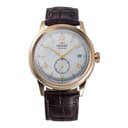
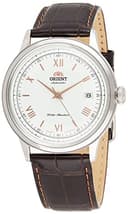
One dress watch to keep: the 38.4 mm small-seconds Bambino. In-house F6222, hand-winding and hacking, about 40 hours, and the only fully published sheet on the page. The small-seconds layout is also the quietest dial here, with the running seconds moved into a sub-dial rather than sweeping across the markers. Its two real weaknesses are the domed mineral crystal and the 30 m rating, and one naming oddity worth knowing: Orient USA calls this reference the “Bambino Version 2 Small Seconds 38mm” while the Amazon listing for the same RA-AP0106S30B calls it Version 7. Same watch. Our Bambino review covers the family in full, and the Bambino alternatives page argues the other side.
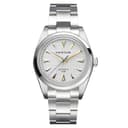
If the crystal is what you care about: the Hestur Miyota 9015 at 36 mm, with a domed sapphire crystal over a named high-beat caliber and a solid bracelet. 28,800 vph gives a visibly smoother seconds sweep than the 21,600 of a Seiko 4R or an NH35. Two honest cons: Hestur’s water-resistance wording is too vague for us to record a figure at all, and there is no service network behind the brand. At 36 mm it is the smallest watch here — see our small-wrist roundup.
A slim wrist and a classic dial: the 38 mm Bambino Version 2, the cheapest Orient on the page. Worth being precise about what is published here: that listing states 38 mm and 30 m and does not name the caliber or the crystal, while Orient’s own sheets for the two Bambino references itdoes document name the F6222 and the F6724 and state domed mineral for both. We have left the unpublished fields blank rather than borrowing figures from a sibling reference. See also the 38 mm roundup.
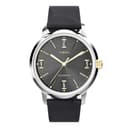
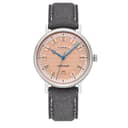
Character over specification: the Timex Marlin Automatic at 40 mm. A domed acrylic crystal, a 1960s-correct case shape, 50 m — better than any Orient here — and an unnamed, non-hacking 21-jewel movement. Nobody buys this watch for the movement, and Timex does not pretend otherwise. Full write-up on our Marlin review, and the head-to-head with the obvious rival is Bambino versus Marlin.
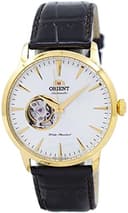
A window onto the balance: the Orient Esteem II open heart. A traditional open-heart dress watch from a company that builds its own calibers, at around $270. The catch is documentation: Orient publishes no page for this reference, so the caliber, crystal, diameter and depth rating all read “Not published” in our table, and we have not guessed any of them. Our open-heart roundup covers the style, and open heart versus skeleton explains how it differs from a cut-away dial.
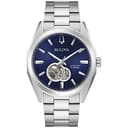
A high-street name with aftercare: the Bulova Surveyor 96A275 at 42 mm, the largest watch here and the only one on a steel bracelet. Bulova’s own page publishes a 42 mm steel case, a mineral crystal, a screw-back case, a 22 mm lug width and a blue three-hand dial with an open aperture over the balance wheel and escapement — and then stops: no caliber, no jewel count, no power reserve, and “WR [Splash Resistant]” where a meter figure should be. A 22 mm lug width on a steel bracelet is genuinely useful, because replacements are everywhere. Our Bulova roundup goes through the range reference by reference.
The most published specification for the least money: the TOPHILL Miyota 9015 at about $200. Sapphire, a named caliber with a stated −10 to +30 second band, 40 mm, 5 ATM, hacking and hand-winding. It is also the one pick that appears on the band below this one, and the 9015’s rotor is famously audible when it spins. If $200 is the real ceiling, start with the under-$200 dress page; if you can stretch, the whole under-$300 band includes divers and field watches at the same money, and our Orient roundup is where the in-house-movement argument gets made properly.