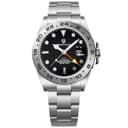
How we picked
1. A real mechanical second time zone, not a 24-hour decoration
Every pick here is a self-winding mechanical watch with a 24-hour hand that tracks a second zone. That rules out the much larger category of quartz “GMT-style” watches, and it also rules out watches whose fourth hand is a fixed 24-hour indicator you cannot set separately. Where a maker does not describe how the hand is adjusted, we say so on the card rather than assuming the better behavior.
2. A live price under $500, checked rather than assumed
The cap is enforced against the live price layer on the date printed beneath the comparison table. Two mechanical GMTs in our registry are excludedby it and it is worth knowing why: the blue-dial Seiko SSK003 survives only as a gray-market import at roughly double the orange SSK005’s price, and the 39.4 mm field-style SBSC011 sits above the cap as well. Both are the same 4R34 caliber as the pick that leads this page, so the cap costs you a dial color and a case shape, not a specification. The uncapped GMT roundup covers all of them.
3. Then whether the caliber is named
Seiko states the 4R34 and publishes a sheet for it. Watchdives and Boderry both state “NH34” on their listings, which is Seiko Instruments’ unbranded GMT caliber — the same relationship the NH35 has to Seiko’s own 4R35, covered in full on our NH35 page and in NH35 versus 4R36. The two Pagani Design GMTs name nothing.
Worth being precise about what we could and could not verify here. Seiko Instruments publishes figures against the NH34 caliber rather than against these two references, and its own movement site did not respond to our request on the date above — so neither new entry carries an accuracy or reserve figure, and neither card claims one. A named caliber is still worth having for the practical reason that it can be serviced: NH-series parts are a stock item for any independent watchmaker, where an anonymous Chinese GMT module may simply not be worth the bench time. Our service-cost guide puts numbers on that.
4. Then the crystal, the depth rating and the case diameter
In that order, because those are the three things makers in this band do sometimes publish. Three picks state sapphire; the Seiko states Hardlex, its own hardened mineral glass; Boderry states nothing at all. Two state 200 m against three at 100 m. Four publish a diameter, running from 40 mm to 42.5 mm — and the one that does not is the $309 Boderry, which is the single most annoying omission on the page.
Why the caliber matters more on a GMT than on a diver
On a three-hand diver, an unnamed movement is a service risk and nothing more. On a GMT it is also a functionrisk, because “GMT” covers two different mechanisms and the price difference between them is real.
Seiko publishes the 4R34 as having an independently adjustable 24-hour hand — so you set the second zone from the crown and the local hour hand stays where it is. That is the arrangement watch people call a caller GMT, and for almost everyone it is the right one: you are tracking home time while you sit at a desk, not re-setting a watch in an airport. The alternative, a flyer or traveler GMT, lets you jump the local hour hand on its own and costs considerably more; nothing in this price band has it, and any listing at $150 implying otherwise is overselling.
What this means in practice is that the GMT hand on an undocumented watch is a question mark rather than a defect. It will almost certainly be a caller-type arrangement, because the cheap GMT modules in circulation are. But nobody has written that down, and setting it is the one part of ownership you will do repeatedly — our setting guide walks through crown positions and the hours you should avoid changing the date in.
What $500 buys, and what it does not
It buys a genuinely useful complication at a price that used to be absurd. A mechanical second time zone was a $1,500 watch a decade ago. The 4R34’s arrival in the 5 Sports case is what broke that, and the NH34 did the same thing one rung lower. Everything on this page is a real mechanical GMT.
It does not buy sapphire from Seiko. The most expensive watch here has the softest crystal on the page apart from the one Boderry declines to describe. Seiko fits Hardlex across the 5 Sports line, which is a hardened mineral glass: tougher than ordinary mineral, far softer than sapphire. On the Mohs scale, the corundum sapphire is grown from sits at 9, quartz — the hard part of ordinary grit and sand — at 7, and glass around 5.5, which is why mineral crystals pick up hairlines in normal wear. Sapphire versus mineral crystal argues it properly, and sapphire automatics under $200 shows how cheap the material has become everywhere except at the household brands.
It does not buy a published accuracy figure. Not one reference here states one, and neither does Seiko’s own 4R34 sheet — it gives the jewels, the beat rate, the reserve and the independently adjustable 24-hour hand, and no daily rate. For scale, the sheet covering Seiko’s 4R35 and 4R36 states +45 to −35 seconds a day against the −4 to +6 average a COSC-certified chronometer must hold, and the two NH34 picks inherit no figure at all. Expect any automatic in this band to run tens of seconds a day off. Our accuracy guide explains when that is normal and when it is not.
It does not buy a thickness figure, except from Seiko. Seiko publishes 13.6 mm for the SSK family, which is a thick watch, and a 161 g weight to go with it. Nobody else states either number. On a 42 mm sports case that matters: thickness is what decides whether a watch slides under a shirt cuff. Our size guide explains how to work with the figures you can get.
And it does not buy a service network below Seiko. Watchdives, Boderry and Pagani Design all sell through retail listings; when the return window closes, the relationship is over. That is the honest reason the Seiko costs what it does, and the reason a named caliber matters so much more on the other four.
Which one, for which buyer
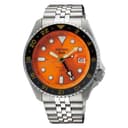
One GMT to own, documented end to end: the Seiko 5 Sports GMT SSK005. Seiko publishes the caliber, the reserve, the jewel count, the beat rate, the diameter, the thickness, the band width, the 10 bar rating, the 4,800 A/m magnetic resistance and the weight — the most complete sheet on this page by a wide margin. Two real caveats: Hardlex rather than sapphire, and the orange dial is the only variant still selling at anything like the price that made this watch famous. Our Seiko 5 Sports GMT review covers the family reference by reference, and our Seiko roundup puts it against the rest of the range.
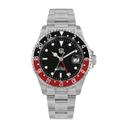
The most checkable specification for the money: the Watchdives WD0014 at about $218. Its listing names the NH34 and then states a 40 mm case, a sapphire crystal, 200 m and a 316L bracelet — four claims the Paganis do not make and one (the depth rating) the Seiko does not match. The saving shows in the bezel: an aluminum insert fades and scratches where ceramic would not. At 40 mm it is also the easiest watch here to wear on a smaller wrist. If a dive-capable case is the real goal, see automatic divers under $500.
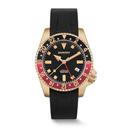
Something nobody else will be wearing: the Boderry Admiral GMT at about $309, the only bronze case in our registry. Bronze develops its own patina, which is the entire appeal and also a maintenance habit — it marks skin and cuffs if you let it stay damp. Boderry names the NH34 and states 200 m, Super-LumiNova markers and an FKM rubber strap, and publishes neither a diameter nor a crystal material, which on a $300 watch is a genuine gap rather than a quibble. Boderry’s own site would not answer our request on the date above, so the blanks in our table stay blank.
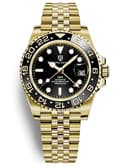
Value, at a size most wrists can take: the 40 mm Pagani Design GMT at about $170. Sapphire, a stated 100 m, a date alongside the GMT hand, and two millimeters less case than its own 42 mm sibling — which is the difference between a watch that fits and one that overhangs. The listing never names the movement, which on this complication is the one specification you most want. Pagani’s inconsistency about that is documented on our Pagani Design page: it names a Seiko caliber when it has one to name, and says “automatic mechanical” on both its GMTs.
The cheapest way into a second time zone: the 42 mm Pagani Design GMT at about $143. Same sapphire, same stated 100 m, same unnamed caliber, bigger case. Buy it if the complication is something you want to try rather than something you have decided you need — and read the big-wrist roundup if 42 mm sounds right. For the honest version of the whole cheap-mechanical-watch question, our are cheap automatics worth it guide is the one to read before you order.
And if the second time zone turns out to matter less than the watch, the whole under-$500 band is where the Prospex divers and the Presage dress watches live, while dress automatics under $300 makes the same caliber-versus-crystal argument in a quieter case.
The watch this band is replacing
Under $500 you are buying a caller GMT, and it is worth knowing exactly what that means against the watch the whole category descends from. Our Rolex GMT-Master II alternatives page sets the two side by side.