How we picked
1. It has to be a dress watch, not a diver on a strap
The entry rule is that the maker or the listing positions the watch as a dress or dress-sports piece, and the design supports it: no rotating dive bezel, no 200 m tool-watch case, no 44 mm diameter. That is what keeps this page distinct from our general under-$200 roundup, which sorts the same price band across every style and whose top pick is a titanium field watch.
2. Then: does anyone name the caliber?
Three of the six do, and they are the top three. A named caliber is not a vanity detail at this price — it is the only way to know what you are buying. Miyota publishes a full sheet for the 9015 (-10 to +30 sec/day, 24 jewels, 28,800 vph, about 42 hours, 3.90 mm high) and Seiko Instruments’ NH35 is the best-documented and best-supported caliber in this market. An unnamed “Japan movement” or “mechanical (self-winding)” might be perfectly reliable; you simply have no benchmark to hold it to, and no watchmaker can quote you for parts on it. Our Miyota roundup and NH35 roundup filter the registry on exactly this.
3. Then: crystal
A dress watch spends its life being looked at from eighteen inches away, which is the distance at which crystal scratches are most visible. Three picks state sapphire (TOPHILL, and both Pagani references — one explicitly anti-reflective); three state nothing. Sapphire under $200 is a genuine achievement rather than an expectation, and it is most of the reason the ranking here does not follow the price order. See sapphire vs mineral crystal for what the difference is worth over a decade.
4. Then: size, and what a dress watch should be
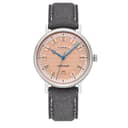
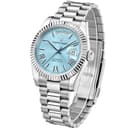
Dress watches are the one category where small is correct rather than a compromise, because the case has to clear a shirt cuff. Two picks publish a diameter: the Pagani DD36 at 36 mm and the TOPHILL at 40 mm. The other four publish nothing, which on a dress watch is a real gap — thickness matters more here than on any other kind of watch and not one maker on this page states it. If fit is your first concern, read our small-wrist page or the size guide before you buy anything unmeasured.
Sapphire and a name, or a design you like?
That is the real choice in this band, and it is worth making deliberately.
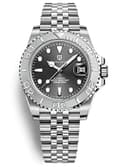
Buy on specification and you take the TOPHILL or one of the Paganis. You get sapphire, a documented movement and a published rating, from a brand nobody at the office will recognise. The PD-1651 adds a jubilee-style bracelet, a fluted-look bezel and 100 m, aimed squarely at a very famous Swiss design — which is its appeal to some buyers and its disqualification to others. Our homage page defines that category precisely, including where the line sits between an homage and a replica.
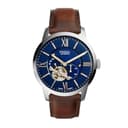
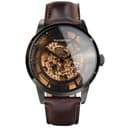
Buy on design and aftercare and you take the Fossil Townsman: a two-hand skeleton automatic with an aperture over the balance at six o’clock, on brown leather, from a brand with stores and a warranty process. Fossil publishes only the name, so every spec field on its card reads “Not published”. That is the honest trade and it is a defensible one.
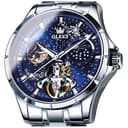
Buy on dial interest and you take the OLEVS: a moonphase-style sub-dial plus an aperture cut over the balance for about $147, which looks like considerably more watch than it is. Our moonphase roundup is clear about what a moon display at this price actually is, and our open-heart page covers the aperture style.
Buy for the least money and you take the FORSINING skeleton at about $60. It exists to show you a mechanism and at this price that is a fair thing to buy, provided you go in knowing that skeleton dials in this band are a decorated movement behind a cut-out dial rather than hand-finished work. Our skeleton roundup records the pattern that makes this page’s point better than anything else: every open-heart and semi-skeleton watch in our registry names a caliber with figures attached, and not one full skeleton names a caliber at all.
What $200 does not buy on a dress watch
Water resistance worth relying on. Two picks state a figure — Pagani’s 100 m on both references and TOPHILL’s 5 ATM — and three state nothing at all. A dress watch does not need a dive rating, but 30 m is splash resistance only and an unstated rating should be treated as less than that. Keep them away from the pool and read what the ratings mean.
An in-house movement. Nothing in this band is made by the company on the dial. Orient’s in-house dress calibers start around $255 and Seiko’s Presage line higher still — which is exactly what our under-$300 page is about, and why the Orient Bambino has been the default answer one band up for years.
A published thickness. The measurement that decides whether a dress watch works under a cuff, and not one maker here states it. That is the single most frustrating gap in the band, and the honest advice is to buy from a seller with a returns policy and check it on your own wrist.