How we picked
1. Removable pillows, because nobody publishes a size
A watch pillow has to be small enough to slide a clasped bracelet over and firm enough to hold the watch in shape. Those pull in opposite directions, which is why a fixed pillow is always wrong for somebody. Across the whole registry the makers that state removablepillows — so you can take one out, or swap a fat one for a slim one — are the ones we would buy for a mechanical collection, and it is the single most under-rated feature in the category. A box with fixed, chunky pillows and a dive watch on a 22 mm bracelet is a daily irritation.
2. The liner, which is the part touching your case
Two picks state a microsuedeliner: both Rothwell boxes. That matters more than it sounds, because a rough synthetic liner is exactly what puts hairline marks on a polished case flank over a decade of the watch going in and out twice a week. It is not a catastrophic failure — it is the difference between a watch that looks cared for and one that looks used.
3. A drawer, for the things automatics come with
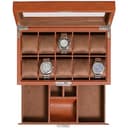
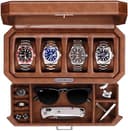
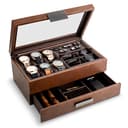
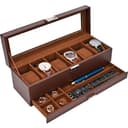
Four of the six picks have one. Every automatic owner accumulates removed bracelet links, a spring-bar tool, a couple of straps and probably a loupe within a year of buying their second watch, and the clutter around a watch collection is rarely more watches. The Rothwell 10-slot’s drawer is deep enough for sunglasses rather than just cufflinks; the Glenor valet goes further and has dedicated space for twelve cufflinks and two pairs of glasses. Our valet-drawer roundup ranks the whole category on exactly this feature.
4. The glass lid, and what it is and is not for
Five of six have one. A glass top is for looking at the collection without opening the box, and that is all — it is display, not security. The one honest caveat: on a box with a small pane rather than a full-width glass top, the watches at the edges are behind wood. Worth knowing is what a glass lid does not give you: none of these boxes is lockable. Exactly two boxes in our whole registry publish a locking lid, and our lockable roundup is clear that a cam lock on a wooden-and-glass case is privacy and child-proofing rather than security.
The thing a box cannot do
It cannot wind. This is obvious when stated and is still the most common disappointment in the category, so here is the full picture.
An automatic stores its energy in a mainspring that the rotor winds while you wear it. Off the wrist it runs down: Seiko publishes about 41 hours for the 4R35 and 4R36, Orient about 40 for the F6922, Citizen 42 for the 8210. Put a watch in a box on Sunday and by Tuesday it has stopped. That does it no harm at all— a stopped automatic is simply a watch at rest, as our guide to letting an automatic stop explains — but it does mean setting the time, and the date, and on a day-date the day as well, every time you rotate back to it. Our guide to setting an automatic includes Seiko’s own caution against setting the date between 9 p.m. and 4 a.m.
If the resetting is the part you object to, a winder is the answer rather than a nicer box — and some products do both. Winders with storage give you one or two rotating positions plus static slots for the rest, which is the right shape for most collections: one or two watches you want ready to wear, the others resting. Our winder vs watch box comparison makes the decision properly, and do automatic watches need a winder is the honest answer for most people, which is no.
Sizing the box to a mechanical collection
Three or four watches: the Rothwell 4-slot with a drawer. An under-filled box looks worse than a full smaller one, and four slots plus a drawer is the honest size for the collection most people actually own rather than the one they plan to. Our small-box roundup covers two to six slots.
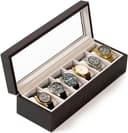
Six watches, nicely: the Case Elegance 6-slot in real wood rather than a printed wrap. Six is the most honest size for most collections and the finish is why people keep recommending this one over the cheaper six-slot boxes — see also our wooden-box roundup.
Ten and growing: the Rothwell 10-slot valet, our top pick. If you are past a dozen, the large-box page goes up to 24 slots.
Watches, cufflinks and glasses in one object: the Glenor Co valet. If the problem is a cluttered dresser rather than unprotected watches, a valet organiser solves more of it than a bigger watch box does.
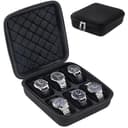
Taking automatics with you: the ProCase 6-slot hard-shell travel case. Structure is the whole point for travel — a rigid shell survives being packed under something, where a roll does not. Our travel-case and roll roundup covers the format, including the full-grain leather roll if you prefer that.
Spending as little as possible: the ProCase 6-slot at about $20, with a glass lid and a small drawer. Below roughly $40 the construction is board with a printed wrap, which protects watches perfectly well and simply will not age the way leather or hardwood does. Our sub-$50 roundup is where that whole band is ranked properly, and the under-$100 page is the band above it.