What Seiko publishes, reference by reference
The whole decision is in this table. Four of the six run the same caliber, five of the six fit the same crystal, and all six carry the same water resistance — so what you are actually choosing between is a few millimeters of case and what is in the box:
| Reference | Caliber | Diameter x thickness | Crystal | Strap, as listed |
|---|
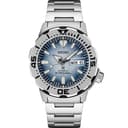
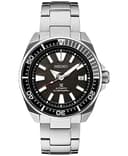
| SRPG57 | 4R36 | 42.4 x 13.4 mm | Hardlex, magnified | Not stated by Seiko |
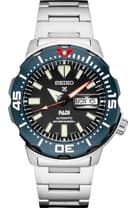
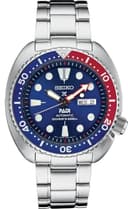
| SRPE27 | 4R36 | 42.4 x 13.39 mm | Hardlex | Steel bracelet |
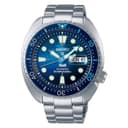
| SRPK01 | 4R36 | 45.0 x 13.22 mm | Sapphire, AR-coated | Steel bracelet |
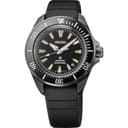
| SRPL15 | 4R35 | 41.7 x 12.3 mm | Hardlex | Silicone |
| SRPF03 | 4R35 | 43.8 x 13.4 mm | Hardlex | Not stated by Seiko |
| SRPE99 | 4R36 | 45.0 x 13.4 mm | Hardlex | Steel bracelet |
Two things jump out of it. The first is that Seiko charges a wide range of money for one caliber: the 4R36 is 24 jewels, 21,600 vibrations an hour and approximately 41 hours of reserve on every reference it appears in, and the 4R35 is the same movement without the day wheel. The second is that only one reference here gets sapphire, and it is not the most expensive one by much.
How we picked
Three criteria, applied before any of the writing:
1. Seiko has to publish the sheet for that exact reference. Not the caliber sheet, not a retailer’s spec block, not a forum consensus — Seiko’s own product page for the reference number on the caseback. That is why the accuracy column is empty on every pick: Seiko publishes +45 to -35 seconds a day for the 4R35/4R36 caliber, and does not restate it per reference, so we do not move the number into a field it was not written for.
2. It has to be a mechanical automatic. Prospex contains a great deal of Solar and quartz, including some genuinely excellent watches, and none of it belongs on a site about automatic watches. If a Prospex has a battery or a capacitor, it is not here.
3. Published specification beats reputation.Where a nickname and a sheet disagree, the sheet wins and the disagreement gets printed. The SRPL15 is the clearest case: Amazon’s listing title calls it a “Samurai” and Seiko’s own page for the reference does not use the word anywhere — it is titled simply “Prospex Automatic Diver”. We kept the watch, which is good, and dropped the name, which is not ours to assign.
What the 200m marking actually certifies
Every pick on this page is marked 200m and every one of them says “diver’s” rather than “water resistant”, and that is a legal distinction rather than a marketing one. Under ISO 6425 a watch may only be marked “Diver’s 200m” if it meets a defined set of requirements — a minimum 100m rating, a unidirectional or lockable elapsed-time bezel, legibility in the dark at 25cm, and testing of every individual watch rather than a sample of the batch. An ordinary water-resistance rating under ISO 22810 is a batch test and promises much less.
Seiko’s pages for these references state that the watch is “suitable for scuba diving” and follows ISO standards for scuba diving. That is the single biggest reason to buy a Prospex over a Seiko 5 Sports that looks almost identical: the 5 Sports diver-style references carry 100m of ordinary water resistance and no diver’s marking at all. Our water resistance guide explains why those two numbers are further apart in practice than they look, and Seiko 5 Sports vs Prospex puts the two lines side by side on the specifications Seiko publishes for both.
The line’s real weakness: Hardlex, not sapphire
Five of these six watches have a mineral crystal. Seiko calls its own formulation Hardlex, and it is better than ordinary glass, but the hardness ranking has not moved: on the Mohs scale glass sits at about 5.5, quartz at 7 and sapphire at 9. Everyday grit — sand, dust, the stuff on a kitchen worktop — is largely quartz, which is why a mineral crystal collects fine hairline scratches over a few years of daily wear and a sapphire one mostly does not.
At the prices these sell for, that is a genuine criticism rather than a quibble, and it is the one thing the Prospex line consistently loses on against watches costing half as much from Orient, Steeldive or any NH35-based micro brand with a sapphire crystal. The exception is the SRPK01: Seiko’s page for that reference publishes sapphire with an anti-reflective coating on the inner surface, in the 45mm cushion case — and it is the dearest watch on this page, which tells you what Seiko thinks the crystal is worth. If a scratch-free crystal is what you care about most, buy that one or buy outside Seiko — our automatics with a sapphire crystal roundup is the honest page for the second option, and the sapphire vs mineral comparison sets out how much the difference is worth paying for.
Which case size, in plain numbers
Three of the six are effectively the same watch at different diameters, so this is the decision most people are actually making:
- 41.7mm and 12.3mm (SRPL15)— the slimmest 200m automatic Prospex Seiko currently publishes a sheet for. Thickness matters more than diameter under a shirt cuff, and this is the only pick here under 13mm.
- 42.4mm (SRPG57, SRPE27)— the middle, and the two picks we would hand to someone buying their first dive watch. Both are 13.4mm or a hair under.
- 43.8mm to 45.0mm (SRPF03, SRPK01, SRPE99)— big watches by any measure. For the SRPK01 Seiko also lists a 47.7mm length, and a figure like that decides whether a watch fits far better than the diameter does.
If your wrist is under about 6.5 inches, start at the top of that list and work down. Our watch size guide explains why lug-to-lug beats diameter for predicting fit, and the small-wrist automatics roundup covers the watches that fit when none of these do.
Lume, and the only maker that publishes a figure
Every pick here uses LumiBrite, Seiko’s own photoluminescent material, and Seiko is unusual in publishing what it does: charged at more than 500 lux for about ten minutes, LumiBrite emits light for about three to five hours in the dark, with no radioactive material involved. Nobody else in this price band publishes a figure at all, which is why the SRPF03carries the lume award on this page — Seiko’s page for that reference names LumiBrite on the hands and the indexes specifically.
Worth knowing where it is applied, too: on the diver’s references Seiko lists LumiBrite on the hands, the indexes and the bezel, which is the detail that makes an elapsed-time bezel usable in the dark rather than decorative. If lume is the whole reason you are shopping, our best lume watchesroundup compares Seiko’s material against the Swiss Super-LumiNova grades other makers name.
What we left off, and why
Four kinds of Prospex were excluded on the rules above rather than on quality, and it is worth being specific because all four come up in searches.
The Alpinist and the rest of the 6R35 SPB line.The green Alpinist is probably the most-searched Prospex there is, it is automatic, and it is genuinely a better watch than anything on this page — a 70-hour reserve, a sapphire crystal and an internal compass bezel. It is not here for a documentation reason: the references live on Amazon are Japan-market imports (SPB121J1 and similar), Seiko’s US site publishes no specification page for them, and we are not going to build a spec table out of dealer listings. It is also well over a thousand dollars on those listings, which is a different page from this one.
Solar and quartz Prospex. Excluded by definition. If a watch does not run on a wound mainspring it is outside what this site covers, and automatic vs quartz explains the trade honestly rather than pretending one is simply better.
The Samurai references.The SRPB51 is live and in stock as we write this, and it is listed at nearly twice what the SRPE27 costs for a watch with the same caliber and a thicker case. At that spread it is an import markup, not a watch recommendation. The SRPL-series references that listings label “Samurai” are here — one of them is a pick — under the name Seiko actually uses.
References that have stopped being purchasable. The SKX007 is the watch half the internet still recommends and Seiko stopped making it. The same churn happens inside the current line: the SRPF77, the sapphire-crystal cushion-case reference this site carded until this week, returned no live Amazon listing at all when we checked on 12 October 2026, which is why the sapphire pick above is the SRPK01 instead. We do not card a watch we cannot send you to a live listing for, and on Prospex that rule changes the picks more often than on any other line we cover.
If the money is the problem
Be honest with yourself about what the Prospex premium buys. Against a Seiko 5 Sports at roughly half the price you are getting a diver’s-rated case, a screw-down crown and lume on the bezel — the same caliber, usually the same thickness, and in the SRPG57’s case a diameter a tenth of a millimeter narrower. If you will never put the watch in water deeper than a swimming pool, that premium buys you very little, and the Seiko 5 roundup is the page to read instead.
Against the wider market it is a tougher argument. At Prospex money you can have an Orient with an in-house caliber and a sapphire crystal, or a 300m-rated NH35 diver with sapphire and a ceramic bezel, and you would be giving up Seiko’s service network and the ISO marking rather than any specification you can point at. The clearest single example of that trade is the Steeldive SD1970, which fits sapphire and ceramic for roughly half the price of the SRPG57 and borrows Seiko’s own 6105 case shape to do it. The other comparison worth making before you commit is Prospex against Citizen’s Promaster automatics, where the price gap and the documentation gap run in opposite directions. Our best automatic dive watches page is the cross-brand version of this one, and best Seiko automatics puts Prospex next to the 5 Sports, Presage and 5 Sports GMT lines if you have not settled on Prospex at all yet.
Living with one
These behave like any 4R35 or 4R36 automatic. They wind from wrist motion, they hold roughly 41 hours off the wrist before stopping, and they can be wound by hand from the crown — Seiko states manual and automatic winding on all of them, so you never have to shake a stopped watch awake. All four 4R36 references show a day as well as a date, and Seiko’s own setting instructions carry one caution worth repeating: do not set the date or the day of the week between 9:00 p.m. and 4:00 a.m.
A screw-down crown has to actually be screwed down before the 200m rating means anything, which our guide to what a screw-down crown is covers. And if a Prospex is going to sit in a drawer between wears, you have the usual choice: reset it when you pick it up, or put it on a winder sized for a Seiko. We argue both sides of that in whether you need a winder at all, and the honest answer for one watch is usually no.