What Orient actually is
Orient is not a marketplace brand that commissions watches, and it is not a Seiko sub-line either. Its own history page dates the company to 1950, when Tama Keiki Co., Ltd. began manufacturing watches, with the name Orient Watch Co., Ltd. adopted in 1951. The part that matters commercially is more recent: Orient merged with Seiko Epson Corporation in 2017, and Epson now runs both the Orient and Orient Star brands “handling everything from planning to manufacturing.”
So Orient sits inside the Seiko Epson group while designing and building its own calibers, which is why an Orient is a genuinely different proposition from a rebadged watch running a bought-in movement. Orient’s own listing for the classic Bambino puts it plainly: the watch is “powered by the in-house caliber F6724, a successor to the original 487-series workhorse movement.” Our automatic watch brands guide sorts the wider field on exactly this line — who makes their own movements and who buys them in.
The four things that decide which Orient you buy
1. The crystal, which is the single biggest hardware difference
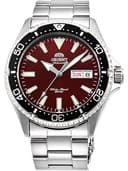
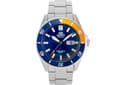
The Kamasu and the Mako II are, on Orient’s published figures, close to the same watch: the same F6922 caliber, the same 200m rating, the same 47mm lug-to-lug, the same 22mm lugs, within 0.4mm of each other on diameter and 0.2mm on thickness. The difference you are paying for is the crystal — sapphire on the Kamasu, mineral on the Mako II.
Whether that is worth the step up is a five-year question rather than a first-week one. Sapphire sits at 9 on the Mohs hardness scale against roughly 5.5 for ordinary mineral glass, and the grit in everyday dust is largely quartz at about 7 — hard enough to mark mineral and not sapphire. If you intend to wear the watch daily for years, the Kamasu is the one that still looks new. If you rotate several watches, the Mako II saves real money for a difference you may never see. Our sapphire crystal roundup works through the trade in full, including where sapphire is the worse choice.
2. The published size, not the line name
Orient publishes diameter, lug-to-lug and thickness for its current references, which makes this the easiest brand on the site to size correctly — if you read the sheet rather than the model name. The spread is wider than the catalog photography suggests:
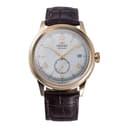
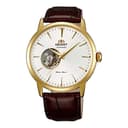
- Bambino small seconds— 38.4mm across, 44mm lug-to-lug, 12mm thick, 20mm lugs.
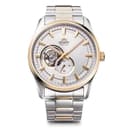
- Semi-skeleton— 40.8mm across, 48.0mm lug-to-lug, 10.9mm thick.
- Kamasu— 41.88mm across, 47mm lug-to-lug, 12.8mm thick, 22mm lugs.
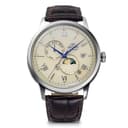
- Bambino Sun & Moon— 41.5mm across, 47.0mm lug-to-lug, 14.2mm thick.
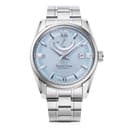
- Kanno— 44mm across, 50.5mm lug-to-lug, 12.9mm thick.
Read those as pairs and the useful patterns fall out. The Kanno is 2.1mm wider than the Kamasu but 3.5mmlonger down the wrist, which is the dimension that decides whether a watch overhangs. The Bambino Sun & Moon is narrower than the Kamasu and 1.4mm thicker than it— a dress watch that is the chunkiest thing on this page, because a box crystal and a day-night disc both add height. And of the references Orient publishes a thickness for, the flattest is the 10.9mm semi-skeleton — the one that will actually slide under a cuff. Our watch size guide covers how to measure your own ceiling before you shop.
3. Whether Orient publishes a sheet at all
This is a criterion, not a complaint, and it splits the page in two. For the references Orient currently sells, the specification is complete down to band width and weight. For the Esteem II and for the Orient Star Standard sold through the Amazon listing here, our source is the retail listing, which does not publish a full sheet — so several rows in those two spec tables read “Not published.” That gap is information: it usually means the reference is at the end of its life, or is a Japan-market model reaching the US through a distributor rather than through Orient’s own catalog.
4. Accuracy, where Orient is better than its reputation on two references
Most makers at this price publish nothing about rate. Orient publishes +25 to −15 seconds a dayfor both the F6B24 in the Bambino Sun & Moon and the F6S22 in the semi-skeleton — a tighter stated band than Seiko’s widely-quoted −35 to +45 for the 4R family. It publishes no figure for the F6922 in the divers, which is why that row is empty on three of the picks here. A published band is a promise about the worst case, not a prediction: our accuracy guide explains what those numbers do and do not commit a maker to.
How we picked
A live, purchasable listing first
Every reference here returned a live offer with a real price through Amazon’s own product API before it was written into this page, and the prices on screen are re-checked daily rather than stored. Orient’s US catalog moves; references come and go under new part numbers. A watch we cannot send you to buy today does not get a slot, however good it is.
Orient’s own figures over the listing’s
Where the maker and the retailer disagree, we use the maker. That is why the Kamasu reads 41.88mm here rather than the rounder 42mm you will see quoted elsewhere, and why the Kanno carries a lug-to-lug figure at all. Six of the eight spec blocks below were re-read from Orient’s own pages for this page; the other two are sourced to the listing, and say so.
One pick per job
Orient sells a dozen watches that differ by dial color. Stacking three variants of the same reference would pad the page without helping anyone, so each slot below answers a different question: a daily diver, a dress watch, a budget diver, a big-wrist diver, two ways of looking at the movement, a complication, and the step up.
Honest trade-offs, including on the winners
Every pick carries its real drawbacks, and some of them are significant: a 41.5mm dress watch that is 14.2mm thick is a genuine constraint, not a footnote. We have not tested any of these watches and do not claim to — what we do instead is set out on our methodology page.
Mako II, Ray II or Kamasu: the question everyone asks
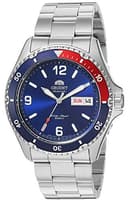
This is the most-asked Orient question and it has a cleaner answer than the forums suggest, because Orient publishes the numbers. The Mako II and the Ray II are dimensionally identical on Orient’s own sheets: both 41.5mm without the crown, both 47mm lug-to-lug, both 13mm thick, both 22mm lugs, both caliber F6922, both mineral crystal, both 200m with a screw-down crown and a 120-click unidirectional bezel. They differ in dial furniture — the Mako’s applied markers and the Ray’s printed dial with a differently-marked bezel. Buy on looks; there is nothing else in it.
The Kamasu is the one real upgrade, and it is the crystal. It is also 0.38mm wider and 0.2mm thinner, which nobody will notice. Our Mako II review and our Kamasu review each go a level deeper, and Seiko Turtle versus Orient Kamasu is the cross-brand version of the same decision.
The Bambino “version” numbers are not sizes
Orient’s dress line is the most confusing naming in affordable watchmaking, and the confusion is not your fault. The 38.4mm small-seconds Bambino picked above is reference RA-AP0106S30B. Orient Watch USA lists it as a “Bambino Version 2 Small Seconds 38mm”; the Amazon listing for the same reference calls it “Version 7”. Meanwhile the watch most people mean by “Bambino Version 2” — the Roman-numeral, onion-crown classic — is a different, larger reference that Orient publishes at 40.5mm with a 46.8mm lug-to-lug.
The practical rule: ignore the version number and buy the reference number, then check the published diameter and lug-to-lug against your wrist. A “version” in Orient’s language is a design generation, not a size, and the retailers do not apply the numbering consistently. Our Bambino review covers the variants in detail, and Seiko 5 versus Orient Bambino is the cross-shop most first-time buyers are actually running.
Where Orient is not the answer
Four honest limits, none of which is a reason to avoid the brand and all of which are reasons to buy the right one.
Presence and service. Fewer retailers stock Orient than Seiko, the owner community is smaller, and if something goes wrong the path back is longer. That is the real trade at this price, and it is why our Seiko versus Orient versus Citizen comparison gives Orient the specification win and Seiko everything around the watch.
Mineral crystals on the cheaper divers. Two of the three divers here run mineral. At this price that is normal rather than mean, but if a clean crystal in five years is the priority you are choosing between the Kamasu and a different brand, not between Orient divers.
Thickness on the dress watches.Orient’s dressier references are not thin by dress-watch standards — 14.2mm on the Sun & Moon, 12mm on the small-seconds Bambino. If you want something that genuinely disappears under a cuff, our dress watch roundup ranks on thickness first.
A thin women’s range.Orient’s ladies’ mechanical line in the US is small and mostly open-heart dress models. Our automatic watches for women roundup carries the Orient that is worth buying alongside the alternatives, which is more useful than padding this page with it.
Where to go from here
If you came for a diver and none of these is quite right, our automatic dive watch roundup puts the Orients against Seiko, Citizen and the micro-brands on the same published criteria. If it was the movement window that caught your eye, the open-heart roundup separates a real aperture from a decorated dial. And if the question underneath all of this is simply how much watch you need to buy, the best automatic watches under $300 is where most of this catalog lands.
The one head-to-head worth reading before you buy
Two of the picks above — the Kamasu and the Mako II — are close enough on Orient’s own figures that most people should decide between them deliberately rather than by price. Our Kamasu vs Mako II comparison lays both sheets out line by line, including the Ray II footnote that catches people out. For the dress side of the range, Presage vs Bambino is the cross-brand version of the same exercise.