Where the two lines actually differ
1. The crystal, and it is not the one you would guess
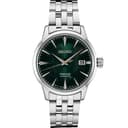
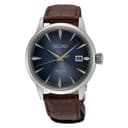
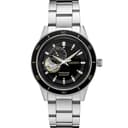
Neither is sapphire. Seiko fits a box-shaped Hardlex — its own hardened mineral glass, shaped with a raised flat top and vertical sides, which is what produces the distortion around the edge of a Cocktail Time dial that people either love or cannot unsee. Orient fits a domed mineral crystal, a gentler curve with less of that effect.
Because both are mineral-class glass, both sit at roughly 5.5 on the Mohs hardness scale, against 9 for sapphire — and the quartz grit in ordinary dust is about 7, which is why either of these will collect fine scratches over years of cuffs and desks. If a sapphire dress watch is what you actually want, our sapphire roundup has the alternatives, and the crystal comparison covers why makers keep fitting mineral anyway.
2. Water resistance: 5 bar against 3 bar
Seiko publishes 5 bar for the Presage references here. Orient publishes 30m for the Bambino, and 3 bar for the Bambino Sun & Moon. Fifty meters covers showering and shallow swimming; thirty meters is splash resistance only — rain and hand-washing, nothing deliberate. Neither is a watch to swim in on purpose, but the Seiko has the larger margin for the ordinary accidents of owning a watch. Our water resistance guide explains what each marking permits and the one habit that ruins more watches than swimming does.
3. The accuracy each maker will print
This one goes Orient’s way, and it surprises people. Seiko publishes +45 to -35 seconds a day for the 4R caliber family, factory adjusted, and publishes no figure at all for the individual Presage references. Orient’s own sheets for its dress calibers — the F6B24 in the Bambino Sun & Moon, the F6S22 in the semi-skeleton — state a daily rate of +25 to -15 seconds. That is a materially narrower published window from the cheaper brand.
Two honest caveats. A published window is a specification, not a promise about the watch on your wrist — Seiko says as much itself, noting that the real daily rate depends on how long the watch is worn, temperature, arm movement and how fully the mainspring is wound. And the +25/-15 figures come from Orient’s sheets for those specific dress calibers rather than from the entire Bambino range. Our accuracy guide covers how to test your own properly before concluding anything.
4. Power reserve, jewels and the caliber families
Seiko: 4R35, 23 jewels, approximately 41 hours, automatic with manual winding, on the SRPK15 and SRPE15; 4R39, 24 jewels, the same approximately 41 hours, on the open-aperture SSA425. Orient: F6222 on the small-seconds Bambino and F6724 on the Version 2, both quoted at approximately 40 hours, both hacking and hand-winding. One hour of published reserve between the two brands. This is not a differentiator; it is two companies building the same class of movement.
The Bambino sizing trap
“Bambino” is a line, not a size, and Orient sells it in several — which is the single most common source of buyer disappointment in this comparison. From Orient’s own sheets:
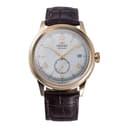
- Bambino small seconds — 38.4mm across, 44mm lug-to-lug, 12mm thick, 20mm lugs, 30m.
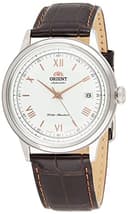
- Bambino Version 2 (TAC00009N0) — 40.5mm across, 46.8mm lug-to-lug, 11.8mm thick, 21mm lugs, 30m, push/pull crown.
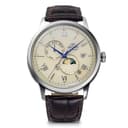
- Bambino Sun & Moon (RA-AK0803Y) — 41.5mm wide, 47.0mm lug-to-lug, 14.2mm thick, 3 bar.
Read those together and two things jump out. The Sun & Moon is 2.4mm thicker than the Version 2 — a box crystal and a day-night disc both add height, so the most dressy-looking watch in the line is the chunkiest thing here and the least likely to go under a cuff. And the Version 2 is sold in more than one case size: the reference in our picks below is the smaller 38mm version its listing states, not the 40.5mm reference on Orient USA’s sheet. Check the case size on the exact reference you are buying, not on the line name. The size guide covers how to work out which one suits you.
So which should you buy?
Buy the Orient Bambino if you want the most dress watch for the money, if a 38mm case suits your wrist better than a 40.5mm one, or if you value a published accuracy window and an in-house caliber over brand recognition. It is the cheaper watch and, on the sheets, it gives away almost nothing.
Buy the Seiko Presage if you want the dial. That is not a dismissal — the Cocktail Time dials are the reason the line exists, and nothing Orient makes at this price has the same depth under a box crystal. The Seiko also has the larger water-resistance margin and the bigger service network.
Buy neither if what you actually want is one watch for everything. A 30m or 50m dress watch is a poor daily companion, and both of these are second watches in disguise. Our everyday-wear roundup filters on 100m and up for exactly that reason, and best automatic dress watches covers the wider dress field if neither of these two is quite it.
For the deeper dives on each line: our Seiko Presage roundup maps the tiers and where the extra money goes, the Orient Bambino review covers the versions properly, and Seiko 5 vs Presage is the comparison to read if you are not yet sure you want a dress watch at all.