The three things that decide a green dial
1. Which green, and under what light
Dial finish changes the color more than the pigment does. A sunrayor sunburst dial is brushed in rays from the center, so the green shifts from near-black at one angle to bright at another — which is why product photographs of sunray dials never look like the watch on your wrist. A matte or flat dial keeps one color in all light, which is more predictable and less interesting. A gradient dial is lighter in the middle and darker at the edge.
Makers rarely label which they have used. The practical move is to look for owner photographs taken outdoors rather than studio shots, and to assume any green that looks electric in a product image will look darker in person. If a specific shade matters to you — matching a strap, say — buy from a retailer with free returns and accept that you may use them.
2. The bezel decides how green the watch reads
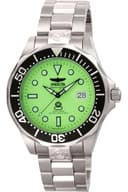
This is the mistake people make most often. The Invicta 10641 below has a green dial and a black top bezel ring, so from arm’s length it is a black watch with a green center. A watch with a green dial and a matching green bezel insert reads green from across a room. Both are legitimate; they are different watches. Read the bezel description, not just the dial.
3. Lume is still the thing you will use daily
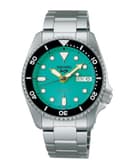
A green dial and a green gloware unrelated. Luminous material is applied to the hands and markers, and most modern lume emits greenish-blue regardless of dial color — Seiko uses its own LumiBrite, the budget divers usually state Super-LumiNova or a BGW9 grade. Two picks here name a luminous material — the Seiko 5 Sports states LumiBrite and the ADDIESDIVE states BGW9 — and the other three do not name one at all. Our best-lume roundup ranks the whole registry on what makers actually put in writing, and what lume is covers how long it should hold.
Crystal: only two of these five are sapphire
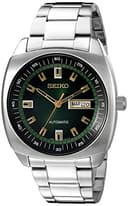
The Orient and the ADDIESDIVE publish sapphire. The Seiko 5 Sports publishes Hardlex, Seiko’s own hardened mineral, the Invicta publishes mineral, and the Recraft publishes nothing for the crystal at all. That split matters on a colored dial more than on a black one, because a scratched crystal haze dulls a saturated color in a way it does not dull black.
The hardness argument is simple: corundum, which is what sapphire is, sits at 9 on the Mohs scale and quartz at 7, and environmental grit is mostly quartz. So mineral glass picks up fine scratches from ordinary life and sapphire does not. The sapphire versus mineral comparison has the trade in full, including sapphire’s own weakness — it is harder but more brittle. If hardness is the deciding factor, the sapphire-crystal roundup is the list sorted on exactly that.
What each price bracket actually buys you here
Around $130, from a brand with no name on the dial
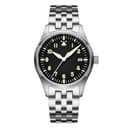
The ADDIESDIVE is the cheapest route to sapphire and a named Seiko NH35A, and its dial is sterile — no logo at all, which is why these are the favorite base for modding. What you give up is information: ADDIESDIVE publishes no case diameter, no thickness and no lug-to-lug for this reference, and its only sizing figure is a bracelet range. You are buying a watch whose dimensions you will discover on arrival. Our Steeldive vs ADDIESDIVE comparison is the longer version of that trade-off.
Around $250, from a Japanese maker
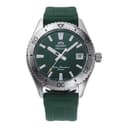
The Orient and the Seikos. Here you get published dimensions, a maker’s warranty, a service network and — on the Orient — sapphire and an in-house caliber whose specification you can read. The Orient is the strongest value on this page for that reason: it is the only pick where the maker publishes a lug-to-lug figure, and 46.5mm on a 39.9mm case means it sits on almost any wrist. Both brands are covered in depth in the Orient roundup and the Japanese-brand buying page.
Around $110, as big as watches get
The Invicta 10641 is the cheapest green automatic we have found anywhere, and it is 47mm with a 300m rating. The price and the size are related: 47mm is a size the established makers abandoned and the value brands did not. If your wrist genuinely wants it, this is a lot of watch for very little money. If it does not, nothing else about the watch will fix that — see the large-wrist roundup for the honest version of that argument and the Invicta roundup for where it sits in that brand’s range.
A note on the one that is not called what you think
The Orient pick is listed on Amazon as an “Orient Mako”. Orient Watch USA’s own page for the same reference, RA-AC0Q11E30B, is titled AC0Q Diver— it is not a Mako, which is a different case with different published dimensions. We follow Orient’s naming in the table above and flag it here because it is a buying trap: if you cross-shop “Mako” listings on the strength of a Mako review, you can end up with a different watch. The actual Mako line is covered on our Orient Mako page, and the name-versus-reference problem is the same one that makes Bambino version numbers so confusing. Buy on the reference number.
What a green dial does not change
Everything mechanical. Dial color has no effect on accuracy, power reserve, servicing or longevity, and a green automatic from a given maker is the same watch as the black one at the same reference family. So the usual questions still decide the purchase: case diameter against your wrist — measure it with our watch size guide — what the water rating permits, and whether the movement is one you can get serviced.
The one practical quirk is strap pairing. Green is harder to match than black or blue: brown and tan leather work, gray and black rubber work, and most other colors fight it. Several of the picks here come on a steel bracelet, which sidesteps the problem entirely. And if you want green on the wrist without a green dial, a green strap on a black-dialed diver is a $20 experiment rather than a $250 one.
Finally, the rating. Two of these five publish 200m or better, one publishes 100m and one publishes 50m — which is hand-washing, not swimming. None of them is an ISO 6425 certified diver. What a water-resistance figure actually permits is the five minutes that saves a watch.