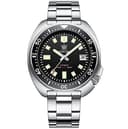
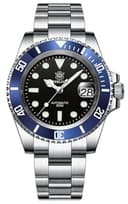
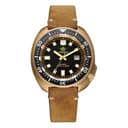
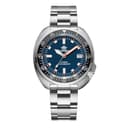
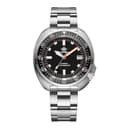
Where the two brands genuinely differ
Published measurements
Steeldive states diameter, thickness and lug-to-lug; ADDIESDIVE states none of the three on the listings we read. This is the single most useful difference between them, and it compounds: the SD1970’s 46.8mm lug span is 2.6mm shorter than the 49.4mm Seiko publishes for its own narrower 42.4mm diver, which is the clearest proof going that diameter and wearing size are different things. You can make that calculation for a Steeldive. You cannot make it for an ADDIESDIVE.
Case construction
Steeldive’s reputation among enthusiasts rests on the cases rather than the movement — 316L steel, a 120-click ceramic bezel, AR-coated sapphire, and on the SD1953 a stated 300m with a screw-down crown. ADDIESDIVE sells the same movement and crystal in a case that is adequate rather than admired, and saves the money at the bracelet and clasp. If you intend to put the watch on a strap anyway, that saving costs you less than it sounds.
Availability
This cuts the other way. ADDIESDIVE listings are consistently in stock; Steeldive’s come and go between sellers, which is normal for the micro-brand end of the market and genuinely annoying when the one you wanted disappears. If a Steeldive pick above shows no live price, that is the mechanism working — our prices come from a daily refresh and a reference with no buyable offer simply shows no number.
What the lume listing says
Both brands make lume claims; one of them names the pigment. ADDIESDIVE’s BGW9 reference prints an actual Super-LumiNova emission code rather than the word “luminous”, and Steeldive states Swiss C3 green plus BGW9 blue on the SD1970. A named code tells you the colour — BGW9 emits blue-green at about 485nm and reads white in daylight; C3 glows green and reads pale yellow-green — but it does not tell you the grade, and grade is what decides how slowly the glow decays. Nobody at this price publishes the grade, and we are not going to pretend otherwise. Our lume roundup only admits watches whose listing names the material.
The thing both brands share: the NH35
Every watch on this page runs the Seiko NH35 (or the 36mm field watch’s unnamed automatic). That is the most important fact in the comparison and the reason neither brand can really out-engineer the other on paper. The NH35 is the same movement family Seiko fits to its own 5 Sports line: it hacks, it hand-winds, parts are everywhere, and any watchmaker will service it — or, more realistically at this price, replace it for less than a service costs. Our NH35 roundup covers the caliber and the watches built around it.
What neither brand publishes is an accuracy figure. Seiko does publish one for its own 4R-series calibers — +45 to −35 seconds a day on the wrist — and the NH35 is the same architecture, but a figure published for one caliber is not a figure published for another, so our spec tables leave accuracy blank. That omission is information too: it is the difference between buying a brand and buying a parts list.
“200m” is not a diver’s certification
Both brands state depth ratings, and neither states ISO 6425 compliance. The distinction is real and worth knowing before you dive with either: a stated pressure rating is the maker’s own claim, while an ISO 6425 “DIVER’S” marking requires a minimum 100m rating, a unidirectional and lockable elapsed-time bezel, legibility in the dark, and testing of every individual watch rather than a sample. A $150 NH35 diver with 200m on the dial will handle swimming and snorkelling comfortably. Treat scuba as a question for a certified watch and a serviced gasket, not for a marketplace homage. The full version is in water resistance explained, and the screw-down crown guide covers the single most common way people flood one of these.
Which should you actually buy?
If you are buying one watch and you want the fewest unknowns, buy the Steeldive. The premium over ADDIESDIVE is small in absolute terms and it buys published dimensions, a better-regarded case and a ceramic bezel with a 120-click action. If you are buying a beater, a second diver, or a watch to find out whether you even like 44mm, buy the ADDIESDIVE and put the difference towards a strap. Both are the same bargain at heart: a documented Japanese movement in a case that costs a fraction of the watch it resembles. Our homage roundup is honest about what that costs you in originality, and the sub-$200 diver list puts both brands up against Seiko, Orient and Invicta at the same money.