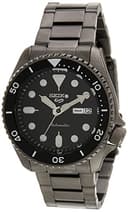
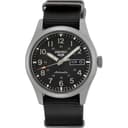
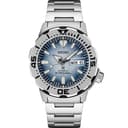
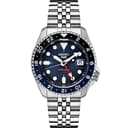
The four Seiko lines, in one paragraph each
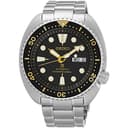
5 Sports is the volume line and the reason Seiko owns the entry-level automatic market. Steel case, Hardlex crystal, 4R36 day-date, a rotating bezel on the diver-styled references and a see-through caseback. It is the cheapest watch here and the one most people should buy first. Our Seiko 5 roundup goes deeper into which reference inside the line to pick.
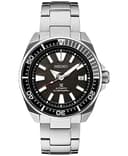
Prospex is the professional-specification line: a screw-down crown, a unidirectional bezel with lume on it, and the regulated Diver’s 200m marking rather than a plain bar figure. You pay roughly a hundred dollars more than a 5 Sports for hardware you can point at.
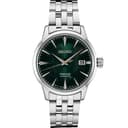
Presage is the dress line. Same 4R movement family, a box-shaped crystal over a textured or lacquered dial, and a case Seiko publishes at 40.5mm across and 11.8mm thick — slimmer than anything else on this page, and the only Seiko here that slides under a shirt cuff. Water resistance drops to 5 bar, which is the trade.
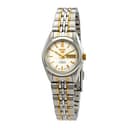
The plain Seiko 5 references — the SYMA and SYMG families — are the survivors of the original line: small, cheap, mechanical, and the only Seikos here sized for a genuinely small wrist. Seiko publishes very little about them, and their spec tables below say so rather than filling the gap.
The specifications that actually sort this page
1. “10 bar” is not a dive rating
This is the single most useful thing to know about Seiko, and it is printed plainly on Seiko’s own pages. The SRPD65 5 Sports has a rotating bezel, a diver’s silhouette and a stated water resistance of 10 bar. The Prospex SRPG57 has the same 4R36 caliber, the same 13.4mm thickness and a stated water resistance of 200m / 660ft diver’s, plus a screw-down crown Seiko lists and the 5 Sports does not.
Those two markings are not synonyms. The diver’s wording is regulated under ISO 6425, which requires a minimum 100m rating, a unidirectional or lockable elapsed-time bezel, legibility in the dark, and testing of every individual piece rather than of a sample. A 10 bar watch is water-resistant and will survive swimming; it is not certified for diving, and Seiko never claims it is. Our Seiko 5 Sports vs Prospex comparison works through the whole gap between the two lines on Seiko’s own numbers.
2. Case size, which Seiko publishes and most listings round
The spread here is wider than the product photography suggests, and all of it comes from Seiko’s own sheets:
- SRPG37 (5 Sports field) — 39.4mm across, 13.2mm thick.
- SRPE15 (Presage) — 40.5mm across, 11.8mm thick.
- SRPG57 (Prospex) — 42.4mm across, 13.4mm thick, and 49.4mm lug-to-lug.
- SRPD65 / SSK003 (5 Sports) — 42.5mm across, 13.4mm and 13.6mm thick respectively.
- SRPF03 (Prospex) — 43.8mm across, 13.4mm thick.
Read those as pairs and the useful fact falls out: the 5 Sports SRPD65 is 0.1mm wider than the Prospex SRPG57 and wears noticeably smaller, because Seiko publishes 46.0mm lug-to-lug for the SRPD65 against 49.4mm for the SRPG57. Lug-to-lug, not diameter, is what decides whether a watch overhangs your wrist — our watch size guide covers how to measure your own ceiling, and the 40mm roundup is the middle ground if everything here reads too big.
3. Hardlex, and the one thing Seiko will not give you at this price
Every Seiko on this page uses Hardlex, Seiko’s own hardened mineral glass, or a box-shaped version of it on the Presage. None of them is sapphire. That is the clearest place where a $150 micro-brand beats a $400 Seiko on paper: sapphire sits at 9 on the Mohs hardness scale against roughly 5.5 for ordinary mineral glass, and the grit in everyday dust is largely quartz at about 7 — hard enough to mark mineral and not sapphire.
Whether that matters is a five-year question rather than a first-week one, and it cuts both ways: mineral glass tolerates a sharp knock better than sapphire, which is part of why Seiko still fits it to tool watches. If the crystal is your priority, our sapphire crystal roundup and the crystal comparison both take the trade apart properly.
4. Magnetic resistance, which Seiko quietly prints
Seiko lists 4,800 A/m of magnetic resistance on the 5 Sports references here — the ISO 764 threshold, the field a watch has to survive while keeping its rate to within 30 seconds a day. Almost nothing else at this price publishes a magnetism figure at all. It is a small thing that tells you what you are buying into: a maker that documents its watches. If yours ever starts running minutes fast, our demagnetizing guide is the first place to look rather than a service counter.
What is not on this page, and why
No Grand Seiko, no Alpinist, no Japan-only reference. The rule on this site is that a pick has to be a watch you can actually buy today through a link we can stand behind, so references that move in and out of US availability are left out rather than listed with a dead button. Seiko also rotates dial colors through reference numbers constantly — the same watch reappears as an SRPD, an SRPH and an SRPJ — so treat the reference numbers here as the versions live now, not as a permanent catalog.
If your question is really Seiko against the other Japanese brands rather than Seiko against itself, the Seiko vs Orient vs Citizen comparison is the page you want, and best Orient watches is the equivalent of this page for the brand that undercuts Seiko on crystal.