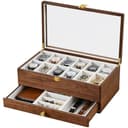
How to read “wooden” on a listing
Three phrases do almost all the work, and they are not interchangeable.
“Solid wood” / a named species
This is the only phrasing that means what you think it means, and it is genuinely rare below several hundred dollars. The tell is a named species and an explicit exclusion — the Waxvorax box below states North American black walnut and states that it contains no MDF and no veneer, which is exactly the shape of claim to look for. No winder in our registry makes it.
“Wooden case” / “wood case”
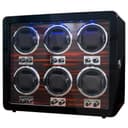
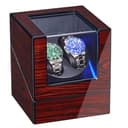
A real wooden carcass, usually with a lacquered or piano finish, generally over an engineered-wood core. Both Oryx winders and the ANWBROAD double sit here. This is the honest middle of the category and it is what most people picture: the thing has heft, the grain runs, and it will still look right in five years.
“Wood-finished” / “wood grain” / “walnut finish”
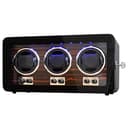
A surface treatment over moulded board or plastic. It can look perfectly good in a dim bedroom and it photographs well, which is why the budget end of the category leans on it so heavily. The ANWBROAD triple below is described this way by its own maker, and we have left it described that way. If you are paying under $60 for “wood”, assume this unless the listing says otherwise.
What the wood costs you in specifications
There is a real trade here and it is worth naming. Not one winder on this page publishes a turns-per-day figure. The makers that do publish TPD ladders — Versa with four steps from 650 to 1,850, Rothwell with five from 650 to 1,950, Barrington with five up to 1,950 — put their money into programs, motors and documentation, and sell them in leatherette or metal-and-glass cases. The makers that put the money into joinery do not publish numbers.
That is not an accident and it is not a scandal; it is two different products aimed at two different buyers. Just know which one you are. If your watch is a Seiko 4R36 or an Orient F6922 — forgiving movements with roughly 40 hours of reserve and no exotic winding requirement — a wooden winder with unlabelled modes will keep it running fine. If you own something with a specific TPD requirement, you need the spec sheet, not the walnut. Our TPD settings guide covers which movements actually care.
Wood and your watches: the two practical notes
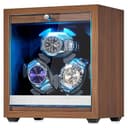
First, a glass-and-wood cabinet is a display case, and display means light. Sustained direct sunlight is hard on strap leather and on dial lacquer, so put the cabinet somewhere out of a window’s path — the same advice we give in how to store automatic watches. Second, a lock on a wooden cabinet is privacy, not security. Wood and glass come apart quickly; if the collection genuinely needs protecting, that is a safe. Our lockable winder page is blunt about exactly this.
If you want wood but do not need winding
This is a more common outcome than the category admits. If the watches you want on display are not in active rotation, a wooden box gives you the whole aesthetic for a fraction of the money and does more for the collection — which is why the solid-walnut Waxvorax sits in the picks above rather than in a footnote. Our wooden watch box roundup is the full list, and winder versus box is the decision itself.