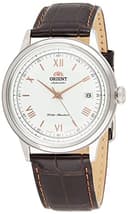
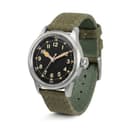
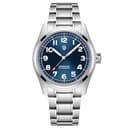
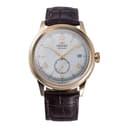
Why 38mm, specifically
Three practical things change at this diameter, and none of them is about taste.
It clears a cuff
A shirt cuff is the constraint nobody mentions in a spec sheet. Case thickness does most of the work here — Orient publishes 12mm for the small-seconds Bambino and 11.8mm for the classic Version 2 — but diameter decides whether the cuff catches the edge of the bezel every time you reach. Under 40mm and over 13mm thick is still a struggle; 38mm and under 12mm is the combination that disappears.
It fits a 6 to 7 inch wrist without overhang
Overhang is the thing you notice in photographs of your own wrist: the lugs end past the flat of the wrist and point outward. On most wrists under about 6.75 inches, a 38mm case with a 44 to 46mm lug span sits entirely on the flat. Our watch size guide has the measuring method, and the small-wrist roundup goes down to 36mm if 38 still reads large on you.
It is the size the designs were drawn at
This one matters more for vintage-styled watches than people expect. A dress watch with a domed crystal and a small-seconds sub-dial was designed around a case this size; scale the same dial up to 42mm and the proportions go soft. The A-11 below is the clearest case: it is a reproduction of a Second World War US military specification, and the original was built at roughly this diameter.
What you give up at 38mm
Two things, honestly. The first is choice. The automatic market below $400 is built around 40mm to 44mm, so the 38mm shelf is genuinely short — this page has four picks rather than six because there are four watches in our registry whose listings publish 38mm, and we do not pad a list with watches that do not meet its own entry condition.
The second is dive specification. Smaller cases usually mean lower water resistance: both Bambinos here are rated 30m, which is splash resistance and nothing more. The exception is the Pagani Design pilot, whose listing states 200m in a 38mm case. If you want to swim in a small automatic, that is the pick on this page — and what the rating actually permits is worth five minutes before you get in the water.
Crystal is the real trade at this price
Three of these four watches use a mineral or domed-mineral crystal, and one uses sapphire. That is not a small difference. On the Mohs hardness scale, corundum (sapphire) sits at 9 and quartz at 7 — and ordinary grit is largely quartz, which is why mineral glass picks up fine scratches from the environment and sapphire does not. A domed mineral crystal buys you the vintage look and will eventually show it; sapphire keeps looking new and costs the character. The sapphire versus mineral comparison is the long version, and the sapphire-only roundup is the list if hardness is the deciding factor.
If 38mm turns out to be the wrong answer
It happens, and it is cheaper to find out before you buy. If 38 reads small to you on the wrist, 40mm is the next step and it is where the best-stocked part of the market lives — our 40mm roundup covers that band. If 38 still reads large, go to 36mm. And if what you actually want is the vintage look at whatever size delivers it, the vintage-style roundup is sorted by character rather than by millimetres.