How we picked
1. The listing has to say it
The entry rule is the same one the blue and green pages use: the maker or the retail listing must state a black dial for that exactreference. A black bezel, a black strap, black indices or a dark photograph do not count. That rule removed one watch we would otherwise have carded. Bulova’s Classic Aerojet 98A187 is a handsome 41 mm open-aperture automatic, and Bulova’s own page describes an “open aperture gray dial” in the body text while the page title says “Black Dial”. When the maker contradicts itself in two places on one page, the honest answer is to leave the watch off the color list and say why — which is what we have done, here and on our Bulova roundup.
2. Layout before shade
There is no useful way to rank black. There is a very useful way to rank what is printed on it. A field dial exists to be read in a second; a Type B flieger dial splits the minute track outside and the hour chapter inside, so the minutes — the thing a navigator cared about — sit on the longest scale; a reverse-panda chronograph uses white registers to separate three sets of hands that would otherwise fight each other. We have ranked on how well each pick does the job its layout was drawn for.
3. What the movement is, and whether anyone says
Two of the six name a caliber you can look up: both Seikos run the in-house 4R36 with hacking, hand-winding and a published accuracy band, and the Invicta’s listing names a Seiko NH35A with 24 jewels. The Sugess names the Sea-Gull ST1901, which is a hand-wound column-wheel chronograph — not an automatic, and the page says so plainly because the ST1901 is the one caliber on this site people buy by accident. The Chotovelli and the Praesidus publish the word “automatic” and nothing else, so their spec rows read “Not published”. That silence is information, and it is the main reason neither is the top pick.
4. Crystal, because a black dial shows everything
Black is the least forgiving background for a scratched crystal: every hairline catches light against it, where a silver or white dial hides them. Only the Sugess publishes sapphire here. Both Seikos use Hardlex, Seiko’s own mineral glass, and the Invicta uses mineral with a magnifier over the date. If that bothers you, our sapphire-crystal roundup filters the whole registry on that one spec, and sapphire vs mineral crystal explains what the difference is actually worth.
Field, flieger, panda: which black dial do you want?
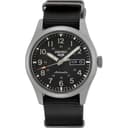
A field dial is the safe answer and the SRPG37 is the best version of it at this money. Plain numerals, a long minute track, luminous hands, no date clutter on the Field Series face. It is the dial you stop noticing, which is a compliment. Seiko publishes 13.2 mm of thickness and that 48.1 mm lug-to-lug on a 39.4 mm case — measure your wrist before you assume a 39 mm watch is small. Our field-watch roundup covers the rest of the category.
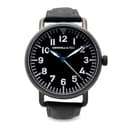
A B-Uhr flieger dial is the enthusiast’s choice, and the Chotovelli Tipo.4 is the most correct one here: triangle at twelve, inner hour chapter, outer minute track. Almost every watch sold as a “pilot watch” today is a loose Type A, with the numerals on one ring. If you have seen the original observation watches and want that layout rather than a nod to it, this is the pick — accepting that Chotovelli publishes no case size, no water resistance and no caliber name. See also our pilot-watch roundup.
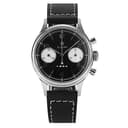
A panda chronograph dial is the most dial per dollar on this page, and the one with the biggest asterisk. The Sugess SS003A puts white registers into a black dial over the Sea-Gull ST1901, the column-wheel chronograph the whole 1963 genre is built on. It is sapphire-crystal, it is beautiful, and it must be wound by hand every day— there is no rotor. If that is a dealbreaker, read our mechanical chronograph roundup first; it explains why nearly every affordable mechanical chronograph is hand-wound.
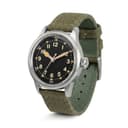
A military reissue dial is a narrower taste and the Praesidus A-11 is the honest version of it: a reproduction of an actual US wartime specification in a 38 mm automatic case, rather than a styling exercise with stencil numerals. The A-11 was a specification several makers built to, not a brand, so a reissue is a design-lineage claim and nothing more — no issue provenance is claimed here or by Praesidus.
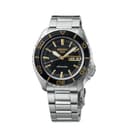
A day-date sports dial is what most first-automatic buyers actually want, and the 5 Sports SRPK99 is the reference point the whole budget market is measured against: the same 4R36, a day and a date, 100 m, an exhibition case back, 42.5 mm across and 14.2 mm thick. It is the biggest and tallest watch here. Our Seiko 5 roundup goes through the line.
What a black dial does not fix
Two things worth saying because the color is so often sold as a solution.
Black does not mean legible. Contrast means legible. A black dial with black-rimmed sub-registers and polished hands can be harder to read at a glance than a silver one; the panda layout exists precisely because solving that problem needed a second color. Judge the hands against the dial, not the dial on its own.
Black does not mean lume. A dark dial makes a watch look like it glows well. Whether it does depends on the compound and how much of it is applied, which is a separate specification most makers here do not publish — our lume roundup only cards watches whose makers name the material. Of the six picks on this page, the two Seikos state LumiBrite; the others state nothing you can check.