How we picked
1. Sapphire stated for the exact reference, and a live price under $200
Both conditions are checked, not assumed. The crystal claim has to appear on the maker’s own listing for the reference we card — not on a sibling model, not in a photograph, not in a review — and the price has to be under the cap on the live price layer on the date printed beneath the comparison table. If a pick drifts over $200, the live price will say so rather than this page pretending otherwise.
Two of the seven go further and state an anti-reflectivecoating, which is a separate specification from the crystal itself. AR coating is what stops a sapphire crystal reading as a mirror in daylight, and it is the single most common thing a cheap sapphire watch leaves out. The BERNY titanium field watch states “AR-coated sapphire” and the Pagani Design DD36 states “anti-reflective”; the other five state sapphire alone, which does not mean they lack a coating — only that nobody wrote it down.
2. Then a named caliber, because that is what you can look up
Six of the seven name the movement: Seiko NH35 or NH35A on the two ADDIESDIVE divers and the Pagani Design pilot, Miyota 9015 on the TOPHILL, Miyota 8215 on the BERNY, and ST16 on the DD36. The 40 mm Pagani GMT names nothing beyond “automatic mechanical,” which is the one real gap in its spec sheet.
A name matters for one practical reason: service. An NH35 is Seiko Instruments’ unbranded workhorse — the same movement family Seiko fits to its own 5 Sports line — and parts for it are available to any independent watchmaker. The same is true of the Miyota calibers, which are made by Citizen’s movement division. When a micro-brand disappears, and some of them will, a named caliber is the difference between a watch that can be repaired and an ornament. Our NH35 roundup and Miyota page go through both families in full.
3. Then the published accuracy band, which almost nobody gives you
Exactly one pick on this page has a caliber with a published daily accuracy specification: the TOPHILL, whose Miyota 9015 Miyota rates at −10 to +30 seconds a day. For context, Seiko’s own 4R35/4R36 sheet states +45 to −35 — a wider window on a watch costing more. The NH35 picks publish no figure at all, and neither does the ST16. That is not a reason to avoid them; it is a reason not to buy a budget automatic expecting quartz-like timekeeping. Our accuracy guide explains what these numbers mean in practice and why a watch running eight seconds fast a day is behaving normally.
4. Then water resistance, read as a number and not as a word
Three picks state 200 m, three state 100 m, and the TOPHILL states 5 ATM. Worth saying plainly: a stated depth rating is not an ISO 6425 diver’s certification. The standard that lets a watch be marked “DIVER’S 200 m” requires every individual watch to be tested, not a sample, along with a unidirectional elapsed-time bezel and dark legibility. Nothing in this price band carries it. Treat 200 m here as “swim and shower without thinking about it” rather than as scuba equipment, and read our water-resistance explainer before you take any watch underwater.
Why sapphire is the specification worth paying for
Scratches happen when something harder is dragged across something softer, and the ranking is published. On the Mohs scale, corundum — the mineral synthetic sapphire is grown from — sits at 9. Quartz sits at 7. Ordinary glass sits at 5.5, and plastic between 2 and 2.5. Everyday grit, sand and household dust are substantially quartz, which is harder than mineral glass and softer than sapphire. That single comparison is the whole argument: a mineral crystal collects hairlines from ordinary life within a year or two, and a sapphire one generally does not.
It is not a free upgrade, and the trade-offs are real. Sapphire is harder but more brittle, so a sharp impact that would dent mineral glass can crack sapphire outright, and replacing it costs more. It is also more reflective without an AR coating. Our sapphire versus mineral crystal comparison argues both sides properly; the short version is that for a watch you intend to wear daily for years, hardness wins, which is why the parent sapphire automatics roundup exists at all. This page is that list with a hard price cap on it.
What $200 buys, and what it does not
It buys a documented movement and a hard crystal. Six of seven name a caliber you can look up, all seven state sapphire, and four state a case diameter. Ten years ago that specification sheet belonged to a watch costing three times as much, which is the genuinely good news about this band.
It does not buy a brand with a service counter. Not one maker on this page operates a service network of its own. ADDIESDIVE, TOPHILL, BERNY and Pagani Design sell through retail listings and that is the end of the relationship; if something fails outside the return window, you are taking the watch to an independent watchmaker. This is exactly why the named caliber matters more here than it would on a Seiko, and it is also the honest reason the big three Japanese makers look expensive by comparison. Our Japanese-brand page makes the case for paying that premium.
It does not buy resale value. A micro-brand automatic is worth what someone will pay for a used micro-brand automatic, which is not much. If the watch is a stepping stone rather than a keeper, that may not matter; if you expect to trade up in two years, a Seiko 5 or an Orient holds a meaningful fraction of its price and these do not. We walk through that trade in full on our Seiko 5 alternatives page, which is the same argument seen from the other side.
It does not buy a thickness figure. Not one pick on this page publishes case thickness or lug-to-lug, and those two measurements decide whether a watch clears a shirt cuff and whether it overhangs a wrist. Diameter, which four of them do publish, is the least informative of the three. Our size guide explains how to estimate fit from the numbers you can get.
And it does not buy an in-house movement. Every caliber here is bought in from Seiko Instruments, Miyota or a Chinese movement house. That is not a criticism — buying a proven caliber is why these watches can be cheap and serviceable at once — but if the appeal of a mechanical watch is that the company on the dial made the mechanism, the entry price is roughly $250 with an Orient. Our Orient roundup covers that step up.
Which one, for which buyer
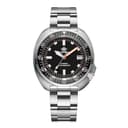
One watch to wear every day, with the best paper trail: the ADDIESDIVE NH35 Diver. Named Seiko caliber, sapphire, 200 m, consistently in stock — and the weak point is the bracelet and clasp, which is where the money was saved and the easiest thing to replace. If the watch in your head is a famous steel diver, it is worth reading our Submariner alternatives page first: sapphire and a 200 m case are two of the lines a sub-$200 watch matches outright, and it names the three that money cannot buy down here.
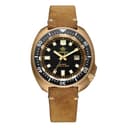
If the bezel is what you look at: the ADDIESDIVE ceramic version, about $20 more. An aluminum bezel insert fades and scratches; ceramic does neither, though it will chip rather than scratch if you knock it hard. Those are different failure modes, not better and worse ones.
Something that goes under a cuff: the TOPHILL Miyota 9015, at 40 mm with a sapphire crystal and the only published accuracy band on the page. The 9015 runs at 28,800 vibrations an hour against the NH35’s 21,600, which gives a visibly smoother sweep, and it is a thinner movement — which is why it turns up in slimmer watches. Its rotor is also famously audible when it spins. Our dress automatics under $200 page covers that end of the band in full.
The lightest thing here: the BERNY full titanium field automatic. Titanium has a density of about 4.5 g/cm³ against 7.5 to 8.0 for stainless steel, and BERNY states titanium for the bracelet as well as the case, which is the detail that decides whether the weight saving survives. It is also the one pick whose Miyota 8215 does not hack, so the seconds hand keeps running while you set the time. Our titanium page covers the material properly, including the part the listings leave out: titanium is softer than hardened steel and marks more easily.
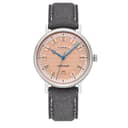
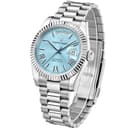
A small wrist: the Pagani Design DD36 at 36 mm, which is also the cheapest watch on the page. Small automatics with real specifications are rare because the segment gets treated as fashion. See our small-wrist roundup and the 38 mm page for the next size up.
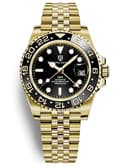
Two time zones: the 40 mm Pagani Design GMT. It is the cheapest mechanical second time zone we can find with sapphire, and the compromise is that the listing never names the caliber. If that matters to you — and on a GMT it should, because the complication is where a cheap movement shows its limits — the honest answer is that a proper GMT starts higher.
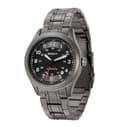
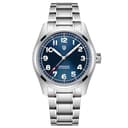
A flieger look: the Pagani Design NH35A pilot at 38 mm, which states the diameter, the caliber, the sapphire and a 200 m rating and publishes nothing else at all. Its styling is borrowed wholesale from the flieger canon, which we say plainly on our homage page and on the pilot roundup.