Dial & Lume

Best Skeleton Automatic Watches Under $200

A skeleton dial is sold as a view of the mechanism - and under $200 not one maker will tell you whose mechanism it is. Six self-winding skeletons from about $50 to $150, ranked by what their makers actually put in writing.

By Stephen V.Last updated How we pick

The short answer

For most buyers the Stuhrling Original Winchester 44 Elite is the skeleton automatic to buy under $200. It is the only pick in this band that is genuinely cut away front and back — the movement isthe dial rather than peeking through a window in it — and it is one of only two picks here whose maker publishes even a case diameter. If you would rather have a company to call than a bigger view of the mechanism, the Fossil Townsman ME3110 is the best-designed watch on the page and comes with a real warranty channel, and the Relic by Fossil skeleton sits under $130 with the same corporate parent behind it. The budget pick is the FORSINING Skeleton at about $60— the cheapest watch we will name that is honestly mechanical. Our one warning applies to the whole band: not one of these six makers names the caliber inside, so nothing here can be looked up, rated or compared on paper. Every pick below carried a live price under $200 on our price check as of November 23, 2026.

A skeleton watch sells one thing: a view of the machine. Which makes this price band genuinely strange, because under $200 not one maker in our registry will tell you whose machine it is.

We checked all six listings on the dates printed under the comparison table. Between them they publish the words “automatic,” “mechanical (self-winding),” “mechanical (automatic)” and “automatic — Japan movement.” Not one names a caliber. Not one publishes an accuracy figure, a power-reserve figure, a crystal material or a water-resistance rating. Two of the six publish a case diameter. That is the entire documented specification of this category: six watches, two numbers.

Compare that with the watch sitting just above the cap. Bulova’s own page for the 43 mm Sutton skeleton (96A208) states a self-winding 21-jewel movement, a domed mineral crystal, a full exhibition case back, a 22 mm lug width and a 43 mm case — for roughly $350. Bulova still does not name the caliber, but it writes down five things nobody under $200 does. That gap is what your money buys when you cross $200, and it is why this page ranks by disclosure rather than by looks. Six picks from about $50 to $150. We have not handled any of them; specifications come from each maker’s own listing on the dates shown, and prices come from a live daily check rather than a number typed into this page.

How this is funded: we earn a commission if you buy through our links, at no extra cost to you. As an Amazon Associate we earn from qualifying purchases. It never changes which watch or winder we recommend, and we’ll tell you plainly when to skip one. Full disclosure.

Quick picks

Ranked on movement, specs and buyer fit. Select a row to jump to the full write-up. We have not tested these — here is exactly what we do instead.

#ProductBest forPriceMovementCase sizeWater resistanceCrystal
1
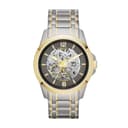
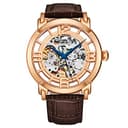
Stuhrling Original Winchester 44 Elite Skeleton Automatic

Stuhrling Original Winchester 44 Elite Skeleton Automatic

The full-skeleton look done properly — front and back cut away so the movement is the dial rather than a window in it. Stuhrling's marketing is loud, but the watch delivers exactly the thing people buy a skeleton for.

Best overall
$129.99 · View on Amazon

Price as of November 23, 2026. #ad How we’re funded

Mechanical (self-winding)44 mmNot publishedNot published
2
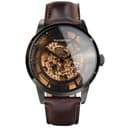
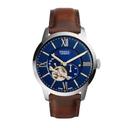
Fossil Townsman Automatic Two-Hand Skeleton ME3110

Fossil Townsman Automatic Two-Hand Skeleton ME3110

The high-street skeleton automatic. Fossil's Townsman is designed first and specified second, which is a fair trade at this price - you are buying a watch that looks considered and happens to be mechanical, from a brand with real aftercare. The aperture over the balance is the dial's one trick and it is a good one.

Best mainstream brand
$133.23 · View on Amazon

$153.1413% off

Price as of November 23, 2026. #ad How we’re funded

Automatic (Japan movement; no caliber named)Not publishedNot publishedNot published
3
Relic by Fossil Automatic Skeleton Dial

Relic by Fossil Automatic Skeleton Dial

The cheapest skeleton automatic here that comes from a company with a warranty department. Relic is Fossil's budget line, so you get a returns path and a real brand behind it — which is worth more at this price than another millimeter of finishing.

Best first skeleton
$81.38 · View on Amazon

$175.0053% off

Price as of November 23, 2026. #ad How we’re funded

Mechanical (automatic)Not publishedNot publishedNot published
4
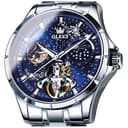
OLEVS Moon Phase Skeleton Automatic (blue dial)

OLEVS Moon Phase Skeleton Automatic (blue dial)

The mid-budget option: a self-winding automatic with a moonphase-style sub-dial and an aperture cut over the balance, at roughly a third of what the Orients cost. It looks like more watch than it is, which is either the appeal or the problem.

Most dial detail
$117.60 · View on Amazon

$338.0065% off

Price as of November 23, 2026. #ad How we’re funded

AutomaticNot publishedNot publishedNot published
5
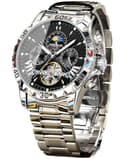
FORSINING Moon Phase Skeleton Automatic

FORSINING Moon Phase Skeleton Automatic

The cheapest self-winding watch here with a moon on the dial, and the one that most needs its marketing read carefully. It is a real automatic; the 'tourbillon' in the listing title is not a tourbillon.

Best open dial work
$49.98 · View on Amazon

Price as of November 23, 2026. #ad How we’re funded

Automatic43 mmNot publishedNot published
6
FORSINING Skeleton Automatic (Leather Band)

FORSINING Skeleton Automatic (Leather Band)

A skeleton automatic for the price of a takeaway for two. It exists to show you the mechanism, and at this money that is a fair thing to buy — as long as you go in knowing nothing about the movement is published.

Best on a budget
$59.99 · View on Amazon

Price as of November 23, 2026. #ad How we’re funded

Mechanical (self-winding)Not publishedNot publishedNot published

Specs read from each maker’s published data and retail listing on August 11 and October 26, 2026. Prices checked live — as of November 23, 2026. “Not published” means the maker does not state that figure; we don’t fill the gap with a guess.

The picks in full

#1Best overall

Stuhrling Original Winchester 44 Elite Skeleton Automatic

The full-skeleton look done properly — front and back cut away so the movement is the dial rather than a window in it. Stuhrling's marketing is loud, but the watch delivers exactly the thing people buy a skeleton for.

Strengths

  • Genuinely skeletonized rather than a small aperture
  • Self-winding mechanical movement with a display back
  • Dress proportions rather than an oversized novelty case

Trade-offs

  • Brand's marketing language oversells the finishing
  • No published accuracy or power reserve figure
MovementMechanical (self-winding)
Stated accuracyNot published
Power reserveNot published
Case size44 mm
Water resistanceNot published
CrystalNot published
Hacks / hand-windsNot published / Yes

Why this one. 'Skeleton' covers everything from a small open-heart window to a fully cut-away movement. This is at the cut-away end, which is the version most buyers actually mean.

Specs read from the product listing and the maker’s published data, on August 11, 2026. “Not published” means the maker does not state that figure.

#2Best mainstream brand

Fossil Townsman Automatic Two-Hand Skeleton ME3110

The high-street skeleton automatic. Fossil's Townsman is designed first and specified second, which is a fair trade at this price - you are buying a watch that looks considered and happens to be mechanical, from a brand with real aftercare. The aperture over the balance is the dial's one trick and it is a good one.

Strengths

  • Genuinely well-designed blue dial and polished steel case for the money
  • Fossil's warranty and service network, which the micro-brands do not have
  • An open aperture onto the balance rather than a full cut-away novelty dial

Trade-offs

  • Fossil names no caliber - the dial says only 'Japan Movt'
  • Fashion-brand mechanical, so resale is close to nothing
  • The listing publishes no case size, crystal or water-resistance figure
MovementAutomatic (Japan movement; no caliber named)
Stated accuracyNot published
Power reserveNot published
Case sizeNot published
Water resistanceNot published
CrystalNot published
Hacks / hand-windsNot published / Not published

Why this one. The ME3280 skeleton Townsman that held this slot after the ME3110 lost its listing has now gone the same way - and the ME3110 is back and purchasable, below where the ME3280 sat. It is the two-hand Townsman automatic on brown leather with a blue dial and an aperture over the balance at six o'clock. Fossil's listing still publishes only the name, which is why every spec field here reads 'Not published'. That silence is itself worth knowing before you compare it to a Seiko.

Specs read from the product listing and the maker’s published data, on October 26, 2026. “Not published” means the maker does not state that figure.

#3Best first skeleton

Relic by Fossil Automatic Skeleton Dial

The cheapest skeleton automatic here that comes from a company with a warranty department. Relic is Fossil's budget line, so you get a returns path and a real brand behind it — which is worth more at this price than another millimeter of finishing.

Strengths

  • Backed by Fossil's distribution and warranty network
  • Skeleton dial at the bottom of the branded market
  • Widely available in several finishes

Trade-offs

  • Movement details are not published
  • Relic's finishing is a clear step below the Fossil-branded lines
MovementMechanical (automatic)
Stated accuracyNot published
Power reserveNot published
Case sizeNot published
Water resistanceNot published
CrystalNot published
Hacks / hand-windsNot published / Not published

Why this one. Relic sits under Fossil the way a supermarket own-label sits under the brand. The advantage over a marketplace name is not the watch, it is the company you can call.

Specs read from the product listing and the maker’s published data, on August 11, 2026. “Not published” means the maker does not state that figure.

#4Most dial detail

OLEVS Moon Phase Skeleton Automatic (blue dial)

The mid-budget option: a self-winding automatic with a moonphase-style sub-dial and an aperture cut over the balance, at roughly a third of what the Orients cost. It looks like more watch than it is, which is either the appeal or the problem.

Strengths

  • Automatic movement with the balance visible through the dial
  • Moonphase sub-dial plus skeleton work at a low price
  • Steel bracelet and a widely stocked listing, so returns are straightforward

Trade-offs

  • Movement is not named anywhere on the listing
  • OLEVS states only 'waterproof' — no ATM or meter figure is published
  • The listing uses the word 'tourbillon', which at this price it is not
MovementAutomatic
Stated accuracyNot published
Power reserveNot published
Case sizeNot published
Water resistanceNot published
CrystalNot published
Hacks / hand-windsNot published / Not published

Why this one. Unnamed movements are the norm at this price. It does not mean the watch is bad, it means nobody has published anything you can check. The ASIN that used to sit here had drifted onto an OUPINKE listing entirely and is now dead; this is a live OLEVS whose own listing names the moon phase and the skeleton work, and whose own product image shows the balance aperture. The 30m rating recorded against the old listing is dropped rather than carried across, because this one publishes no rating at all.

Specs read from the product listing and the maker’s published data, on October 26, 2026. “Not published” means the maker does not state that figure.

#5Best open dial work

FORSINING Moon Phase Skeleton Automatic

The cheapest self-winding watch here with a moon on the dial, and the one that most needs its marketing read carefully. It is a real automatic; the 'tourbillon' in the listing title is not a tourbillon.

Strengths

  • A genuine self-winding movement at an extremely low price
  • Open dial work that is unusually elaborate for the money
  • Nothing to lose if it is not for you

Trade-offs

  • The listing calls a rotating balance display a 'tourbillon'. It is not one
  • No published specifications of any kind
MovementAutomatic
Stated accuracyNot published
Power reserveNot published
Case size43 mm
Water resistanceNot published
CrystalNot published
Hacks / hand-windsNot published / Not published

Why this one. A real tourbillon costs thousands and puts the entire escapement in a rotating cage. Budget listings routinely apply the word to an open balance wheel. Assume the word means nothing below about $1,000.

Specs read from the product listing and the maker’s published data, on August 11, 2026. “Not published” means the maker does not state that figure.

#6Best on a budget

FORSINING Skeleton Automatic (Leather Band)

A skeleton automatic for the price of a takeaway for two. It exists to show you the mechanism, and at this money that is a fair thing to buy — as long as you go in knowing nothing about the movement is published.

Strengths

  • Open dial shows the gear train and balance wheel
  • The cheapest genuinely mechanical watch we would name

Trade-offs

  • Nothing published about the caliber, accuracy or reserve
  • Leather band and case finishing are exactly what the price suggests
MovementMechanical (self-winding)
Stated accuracyNot published
Power reserveNot published
Case sizeNot published
Water resistanceNot published
CrystalNot published
Hacks / hand-windsNot published / Not published

Why this one. Skeleton dials at this price are usually a decorated Chinese movement seen through a cut-out dial, not a hand-finished one. Enjoy it for what it is.

Specs read from the product listing and the maker’s published data, on August 11, 2026. “Not published” means the maker does not state that figure.

How we picked

1. It has to be genuinely mechanical, and genuinely self-winding

This is not a formality at this price. Plenty of cheap “skeleton” watches are quartz movements behind a cut-out dial, with a sweeping seconds hand chosen to imitate a mechanical beat. Every pick on this page states a self-winding mechanical movement on its own listing — a rotor winding a mainspring, no battery — and nothing here was included on the strength of a photograph. If you want the test you can run on any watch in a shop, our identification guide walks through it, and how automatic watches work explains the power flow you are looking at through the dial.

2. A live price under $200, checked rather than assumed

The cap is enforced against the live price layer on the date printed beneath the comparison table, not against a list price or a sale we remember. In practice this band is not tight: the six picks run from about $50 to about $150, which leaves $50 of headroom under the cap and is why there is no “just over” section at the bottom of this page. If a pick drifts above $200, the live price will say so rather than this page pretending otherwise.

3. Then disclosure, which is the only thing that separates them

With no caliber, no accuracy band and no reserve figure anywhere in the category, the ranking has to be built from what little each maker does commit to in writing, plus one thing that is not a specification at all: whether there is a company behind the watch. Two of these six are Fossil Group products, which means a warranty department and a returns path. The other four are marketplace brands, where the relationship ends when the return window closes. At $50 that is a fair trade. At $150 it is worth thinking about.

4. And the listing language has to survive being read closely

Two picks on this page — the FORSINING moon phase and the OLEVS — use the word tourbillon in their listings. Neither watch has one, and we have left the word in their cons rather than quietly ignoring it, because it is the single most common piece of misdirection in this price band. More on that below.

What “skeleton” actually covers

The word is used for three different things, and the difference decides whether you can read the time.

A full skeleton removes the dial material so the movement itself is the face — bridges, wheels and barrel visible straight through. The Stuhrling Winchester is the clearest example here, cut away front and back. A semi-skeleton keeps a complete set of markers and opens a large window in the middle. An open heart is a conventional dial with a single aperture, usually at 9 or 6 o’clock, framing the balance wheel — which is what the Fossil Townsman and both moon-phase picks give you. If you care which of the three you are buying, we lay the distinction out properly in open heart versus skeleton watches and pick within the narrower style on our open-heart roundup.

The legibility consequence is ours, reasoned from the geometry rather than claimed by any maker: the more dial you remove, the more hour markers and hand outlines you lose against a moving background. A full skeleton is a watch you lookatmore often than you read. That is not a criticism of the category — it is the point of it — but it is worth knowing before you buy one as your only watch.

The tourbillon word, and why it is not one

A tourbillon mounts the escapement and balance wheel in a rotating cage, so the whole regulating organ turns through 360 degrees to average out positional error. It was conceived by John Arnold, developed by Abraham-Louis Breguet and patented by Breguet on 26 June 1801. For nearly two centuries it stayed rare: fewer than a thousand are believed to have been made between 1801 and 1945, and the first automatic tourbillon wristwatch did not arrive until Audemars Piguet launched its Calibre 2870 in 1986.

What budget listings call a tourbillon is an open balance wheel— a cut-out over the oscillating balance, which every mechanical watch already has and which does not rotate as an assembly. It looks a little like the real thing through a dial aperture. It is not the real thing, and nothing at this price is. Treat the word as decoration below roughly $1,000, and treat a listing that uses it as a listing that will stretch other words too.

We are not telling you to avoid those two watches over it. We are telling you that on a page where nobody publishes a caliber, how a maker uses language is one of the few signals left.

What $200 buys, and what it does not

It buys a real mechanical watch. That is not nothing. A self-winding movement with a visible balance, assembled and sold with a warranty of some kind, for the price of a decent strap, would have been impossible to take seriously twenty years ago. Every pick here genuinely winds itself from wrist motion.

It does not buy a specification sheet. Six picks, and between them: no caliber, no accuracy band, no power reserve, no crystal material, no water-resistance figure, and a case diameter on two of the six. If you want a number to hold a watch to, the entry price is higher. Our NH35 roundup and Miyota page both exist because a namedcaliber is the single most useful thing a budget maker can publish — Seiko Instruments and Miyota publish figures for theirs, so you inherit them.

It does not buy a water-resistance claim you can rely on. Not one of these six publishes a meter or ATM figure. Several say “waterproof,” which under the water-resistance standard means nothing without a number attached. Treat every watch on this page as dry-wrist only: hand-washing, rain, nothing else. Our water-resistance explainer covers what the ratings mean when they are published.

It does not buy serviceability. This is the real long-term cost and it follows directly from the missing caliber name. A watchmaker can service an NH35 or a Miyota 8215 from stock parts; an unnamed Chinese automatic may not be worth the bench time, and a full service often costs more than the watch did. Our service-cost guide puts real numbers on that, and are cheap automatic watches worth it is the honest version of this whole question.

And it does not buy accuracy. With no published band, there is no figure to hold the watch to — which cuts both ways. A watch running twenty seconds a day fast is not obviously faulty if nobody ever said what it should do. Our accuracy guide explains what published bands look like at this end of the market, and what a jewel count does and does not tell you unpicks the one number these listings do like to print.

Which one, for which buyer

The maximum skeleton effect: the Stuhrling Winchester 44 Elite. Cut away front and back in dress proportions rather than a novelty case, with a display back and a stated 44 mm diameter — one of only two diameters published on this page. Stuhrling’s marketing language oversells the finishing, which we say plainly, and there is no accuracy or reserve figure. At 44 mm it is a big watch; check our size guide before you commit, and see the big-wrist roundup if that appeals.

A watch you want to look well-designed first: the Fossil Townsman ME3110. It is the best-looking thing on the page — a blue dial, polished steel case, brown leather strap, and one well-judged aperture over the balance at six o’clock rather than a full cut-away. It is also the clearest statement of the trade: Fossil publishes nothing(the dial says only “Japan Movt”), and in exchange you get a warranty, a service channel and a watch that reads as considered rather than cheap. Fashion-brand mechanical means resale is close to nothing. Our full skeleton roundup shows what the next $150 adds.

A first skeleton automatic, with somebody to call: the Relic by Fossil. Relic is Fossil’s budget line, so it carries the same distribution and warranty network at around $120, and it comes in several finishes. The finishing is a visible step below the Fossil-branded Townsman and the movement details are unpublished. Think of it as the supermarket own-label version of the pick above — the advantage is the company, not the watch.

Maximum dial interest: the OLEVS moon phase, at about $150 on a steel bracelet. A moon-phase sub-dial plus an aperture over the balance is more happening on one dial than anything else here, and the bracelet makes it feel like more watch than the price suggests. Three honest cons: the movement is unnamed, OLEVS publishes no water-resistance figure at all, and the listing says “tourbillon.” If a moon phase is the actual goal rather than a decoration, our moonphase roundup covers the watches that do it properly, including the Orients that publish their calibers.

The most elaborate open dial for the least money: the FORSINING moon phase, at about $50. It is a genuine self-winding watch with more visible dial work than things costing three times as much, it publishes a 43 mm case size, and it publishes nothing else. Same caveat on the word tourbillon. Buy it as a way of finding out whether you like the look, not as a watch you expect to keep.

The cheapest honest mechanical watch here: the FORSINING Skeleton on leather, at about $60. Open dial, visible gear train and balance, and a price that makes the missing specification sheet a reasonable trade rather than an insult. The strap and case finishing are exactly what $60 implies. If this is where your budget actually sits, read automatics under $100 next — some of those spend the money on a named movement instead of an open dial, which is the better buy for most people and is the trade this page exists to make visible.

And if the view of the mechanism matters less than it did three paragraphs ago, the full under-$200 list and the dress automatics under $200 both include watches at this money whose makers name the caliber, state the crystal and publish a depth rating — and one band up, dress automatics under $300 is where an in-house Orient caliber with a full published sheet comes into range. That is the honest comparison, and we would rather you made it than skipped it.
Frequently asked questions

What is the best skeleton automatic watch under $200?

The Stuhrling Original Winchester 44 Elite, at about $130. It is the only pick in this band that is genuinely cut away front and back, so the movement is the dial rather than a window in it, and it comes in dress proportions with a display case back. The trade-offs are real: Stuhrling publishes no caliber, no accuracy figure and no power reserve, and at 44mm it is a large watch.

Can you get a real automatic skeleton watch under $200?

Yes. Every pick on this page states a self-winding mechanical movement on its own listing, so there is no battery and the rotor winds the mainspring from wrist motion. What you cannot get under $200 is a published specification: none of the six names its caliber, states its crystal material or publishes a water-resistance figure, and only two publish a case diameter.

Why don't cheap skeleton watches name their movement?

Because naming it invites comparison. A Seiko NH35 or a Miyota 9015 comes with published figures for jewels, beat rate, power reserve and accuracy, so a maker that names one inherits a spec sheet buyers can check. An unnamed Chinese automatic has none of that attached, which keeps the listing short and the watch cheap. It is not evidence the watch is bad - it is evidence there is nothing to look up.

Is 'tourbillon' on a cheap skeleton watch real?

No. A tourbillon mounts the escapement and balance wheel in a rotating cage, a complication patented by Breguet in 1801 and so difficult that fewer than a thousand are believed to have been made between 1801 and 1945. What budget listings label a tourbillon is an open balance wheel, visible through a dial aperture, which every mechanical watch already has. Two picks on this page use the word; neither watch has the complication.

Can I swim or shower with a skeleton watch under $200?

Treat all of them as dry-wrist only. Not one of the six publishes a water-resistance figure in meters or ATM, and 'waterproof' with no number attached is not a rating. Skeleton cases also have more sealing surfaces to get wrong than a solid-dial watch. Hand-washing and rain are fine; swimming, showering and anything with pressure behind it are not.

Will a $150 skeleton automatic keep good time?

Nobody has said what it should do, which is the real answer. None of these makers publishes an accuracy band, so there is no figure to hold the watch to - whereas Seiko publishes +45 to -35 seconds a day for its 4R36 and Miyota publishes -10 to +30 for the 9015. Expect a budget automatic to run tens of seconds a day off and to vary with how you store it overnight.

Can a cheap skeleton watch be serviced?

Often not economically. A watchmaker can service a named caliber like an NH35 or a Miyota 8215 from stock parts; an unnamed movement may not be worth the bench time, and a full service frequently costs more than the watch did. Buy at this price on the understanding that the watch is close to disposable, and that the two Fossil Group picks at least give you a warranty channel while it is new.

Skeleton under $200, or save for the Bulova?

It depends on whether you want the look or a documented watch. Bulova's own page for the 43mm Sutton skeleton (96A208) states a self-winding 21-jewel movement, a domed mineral crystal, a full exhibition case back and a 43mm case at roughly $350 - five written specifications more than anything under $200 offers, though Bulova still does not name the caliber. If the watch is a curiosity, buy cheap. If it is going to be your mechanical watch, the step up is worth saving for.

Is a skeleton dial hard to read?

Generally yes, and that is inherent rather than a flaw in any one watch. The more dial material a maker removes, the fewer hour markers and hand outlines survive against a moving background. A full skeleton like the Stuhrling is a watch you look at; an open-heart design like the Fossil Townsman keeps a conventional dial and opens one window, which is the compromise most people are happier with day to day.

Sources

  • Tourbillon - Wikipedia — What the word actually describes, for the budget listings that borrow it: "In a tourbillon the escapement and balance wheel are mounted in a rotating cage, with the goal of eliminating errors of poise in the balance giving a uniform weight." It was "Conceived by the British watchmaker and inventor John Arnold", developed by Abraham-Louis Breguet and "patented by Breguet on 26 June 1801". On rarity: "The rarity of tourbillons persisted for nearly two centuries, with fewer than a thousand believed to have been made between 1801 and 1945." Audemars Piguet's Calibre 2870 of 1986 was "the world's first automatic tourbillon wristwatch" (accessed November 17, 2026)
  • Mechanical watch — Wikipedia — Reference walk-through of the power flow in a mechanical/automatic watch: rotor → mainspring → gear train → escapement → balance wheel (accessed July 21, 2026)
  • Automatic watch — Wikipedia — Reference on self-winding watches: most automatics can also be wound by hand at the crown, and a slipping bridle on the mainspring barrel makes overwinding by a rotor or a winder mechanically impossible (accessed August 11, 2026)
  • Jewel bearing - Wikipedia — Reference on watch jewel bearings: they are made from corundum, usually synthetic sapphire or synthetic ruby, and reduce pivot friction - the static coefficient of friction for sapphire-on-steel is 0.10-0.15 against 0.35 for brass-on-steel. A 'typical fully jeweled time-only watch has 17 jewels: two cap jewels, two pivot jewels and an impulse jewel for the balance wheel, two pivot jewels and two pallet jewels for the pallet fork, and two pivot jewels each for the escape, fourth, third, and center wheels.' Jewel bearings were invented in 1704 by Nicolas Fatio de Duillier, Peter Debaufre and Jacob Debaufre; synthetic production was invented by Auguste Verneuil in 1902. Manufacturers 'traditionally listed the number of jewels prominently on the watch face or back, as an advertising point' (accessed October 11, 2026)
  • Bulova - Sutton Automatic 96A208 product specification — Bulova's own page for the 43mm Sutton 96A208: a 'self-winding 21-jewel movement' with no caliber named, a 43mm silver-tone stainless steel case, a 'Domed Mineral Crystal', 'water resistance to 30 meters' in the description against 'WR [Splash Resistant]' in the details panel, a skeletonized black three-hand dial, a full exhibition screw-back case, a steel bracelet with a push-button deployant clasp and a 22mm lug width. No power reserve is stated for this reference (accessed October 26, 2026)
  • ISO 22810:2010 — Water-resistant watches — Defines the requirements, test methods and permitted markings for ordinary water-resistant watches (daily use / swimming, not scuba diving) (accessed July 21, 2026)

Keep reading