How we picked
1. A real mechanical GMT hand, not a 24-hour marker
The entry rule is an independently set 24-hour hand driven by a mechanical movement. That excludes quartz dual-time watches, and it excludes the many budget divers whose bezel carries 24-hour markings with no fourth hand to use them. Two calibers do nearly all the work in this category: Seiko’s own 4R34 and Seiko Instruments’ unbranded NH34, which stand in the same relationship as the 4R35 and the NH35.
2. Then: does the listing name the caliber?
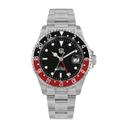
Four of six do. Watchdives and Boderry both state an NH34; both Seikos are 4R34. The two Pagani Design GMTs say “automatic mechanical” and nothing more — which, for a watch that has to contain a specific and relatively unusual complication, is a meaningful silence. They are still the cheapest way into the category by a wide margin.
3. Then: size, because the original is 40mm
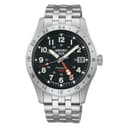
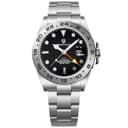
The GMT-Master II is a 40 mm watch, and only two picks here match it: the Watchdives and the 40 mm Pagani. Both Seiko SKX-cased GMTs are 42.5 mm, which is noticeably more watch, and the field-style SBSC011 is the outlier at 39.4 mm with a published 47.9 mm lug-to-lug — the smallest mechanical GMT in our registry and the only one that will suit a genuinely slim wrist. Our 42 mm page covers what the larger size actually wears like.
4. Then: crystal, bezel and what is missing
Watchdives and both Paganis state sapphire. Both Seikos use Hardlex, Seiko’s hardened mineral glass, with a date magnifier on the SKX-cased pair. Boderry publishes no crystal material and no diameter at all, which on a $300 watch is a real gap — and the brand does publish a diameter on its titanium field watch, so the silence is about this listing rather than the maker. Nothing here has a ceramic bezel insert.
Caller or flyer: the question that decides everything
A caller GMT keeps the 12-hour hand on home time and lets you set the 24-hour hand to a second zone from the crown. It is designed for someone calling another country, which is where the name comes from. Setting it when you land means resetting the main time and losing the second zone until you do it again.
A flyer GMT keeps the 24-hour hand on home time permanently and lets you jump the local hour hand forward or back an hour at a time as you cross zones, without stopping the watch. That is what caliber 3085 introduced in 1982 and what every GMT-Master II has done since. No watch on this page does it, and no watch on this page claims to.
It is worth being blunt about the implication: if you are buying a GMT because you travel, none of these is the right watch and the honest advice is to save. If you are buying one to keep an eye on another time zone, or because you like the look, every one of them does that job perfectly and the cheapest costs $119. Our main GMT roundup and GMT watches under $500 sort the same field on their own terms.
Which one, for whom
Most people: the Watchdives. 40 mm, named caliber, sapphire, 200 m, steel bracelet, about $218. Accept the aluminium bezel insert, which will fade the way the pre-2007 originals did.
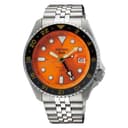
A brand you can take to a watchmaker: the Seiko SSK005. It is the only SKX-cased 4R34 GMT still selling at anything like a normal price — the black SSK001 has no listing at all and the blue SSK003 survives only as a grey import at roughly double. The dial variants are cosmetic; the movement is identical across the line, so colour preference is the only reason to pay the import premium.
A smaller wrist: the Seiko 5 Sports Field GMT SBSC011. 39.4 mm, 47.9 mm lug-to-lug, no dive bezel, a red 24-hour hand on a plain dial. It is also the most expensive pick here, because it is a Japan-market reference sold as an import.
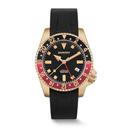
Something nobody else has: the Boderry Admiral. A bronze case that will patina, an NH34 and a stated 200 m. The patina is either the appeal or a maintenance job you did not ask for — decide which before you buy.
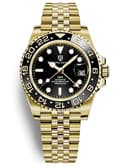
Least money: the Pagani Design GMT. $119 for a mechanical GMT with sapphire and a stated 100 m, in styling that borrows from the original and makes no secret of it. Take the 40 mm version if your wrist is under about 7 inches. Our Pagani Design guide covers which of that brand’s watches are actually worth buying, and our homage page draws the line between an homage and a replica.