What each watch actually is
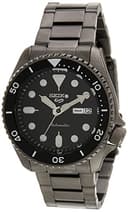
The Seiko 5 Sports
A 100 meter sports automatic running Seiko’s 4R36 caliber, which Seiko publishes openly: automatic with hand winding, 24 jewels, 21,600 vibrations per hour, roughly 41 hours of power reserve, day and date, and an accuracy specification of about −35 to +45 seconds a day worn on the wrist. It hacks and it hand-winds. Crystal is Seiko’s own Hardlex mineral glass rather than sapphire.
It is not a dive watch despite the styling — Seiko dropped the diver’s rating from the 5 line when it relaunched it, which is a genuine and frequently missed change from the old SKX models.
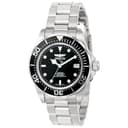
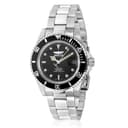
The Invicta Pro Diver 8926OB
A 200 meter automatic with a screw-down crown, an exhibition caseback and a mineral crystal, at roughly a third of the Seiko’s price. Its case shape is openly derived from a very famous Swiss diver, which is most of why it looks like it costs more than it does.
Invicta does not publish a caliber specification in any meaningful sense — its listing labels the movement with an internal code rather than naming a caliber family, and states no accuracy figure. That is why the spec table below prints “Not published” in several rows, and that omission is genuinely informative: it is the clearest single difference between these two companies.
The four places they diverge
1. What the maker will tell you
Seiko publishes its caliber data, hosts service documentation and will repair the watch. Invicta publishes a price and a photograph. For a watch you intend to own for years, that gap matters more than any individual specification, because it decides what happens when something goes wrong.
2. Finishing, and how the watch reads in person
The Invicta’s specification is arguably better — 200m against 100m, a screw-down crown, an exhibition caseback. What it does not have is Seiko’s consistency: dial printing, hand finishing, bracelet quality and bezel action are all noticeably better on the Seiko, and those are the things you look at every day.
Neither watch has a sapphire crystal. Both use mineral glass, which sits around 5.5 on the Mohs hardness scale against 9 for sapphire, and everyday grit is largely quartz at 7 — so both will collect fine scratches. If that matters, our sapphire roundup has the alternatives.
3. Water resistance, where Invicta genuinely wins
200m with a screw-down crown against 100m without one. On the specification, the cheaper watch is the more waterproof watch, and it is not close. Neither carries an ISO 6425 DIVER’S marking, which requires testing every individual watch rather than a production sample — our water resistance guide explains what the ratings permit.
4. Resale, and what happens when you move on
A Seiko 5 holds a meaningful fraction of its price second-hand. An Invicta holds very little. Since a first automatic is frequently sold within two years as tastes settle, the real cost of the Seiko is smaller than the sticker gap suggests — though not smaller than the gap in cash you need on day one.
Who should buy which
Buy the Seiko 5 if this is a watch rather than an experiment. The finishing, the published caliber, the service path and the resale all point the same way, and nobody who has bought one has needed to be talked into keeping it. It is the right default answer and the reason it is the consensus.
Buy the Invicta if $250 is genuinely more than you want to spend to find out whether you like mechanical watches at all. It is a functioning automatic with a 200m case for under $100, and the honest failure mode is that you outgrow it, not that it breaks. Anyone who tells you this is a shameful purchase is confusing taste with advice.
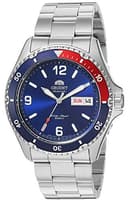
Buy neither if what you actually want is a diver, in which case the Orient Mako II sits between them on price and beats both on movement pedigree — a 200m case with Orient’s own in-house F6922 caliber that hacks and hand-winds. It is the most frequently overlooked answer to this exact question.
And if the Invicta is the side you are leaning toward, the 8926OB is not the only option in that range: our roundup of the best Invicta automatic watches compares five of them, including the two-tone 8927 that names its caliber and a 48mm Grand Diver rated to 300m. The other budget brand people cross-shop at this price is Pagani Design, which fits sapphire where Invicta fits mineral — that head-to-head is Pagani Design vs Invicta.
Whichever you choose, our guide to choosing an automatic watch covers the five decisions that matter, and the entry-level roundup has the rest of the field.