How we picked
1. A dress watch, judged on thickness rather than diameter
A dress watch has one job a sports watch does not: it has to go under a cuff. The measurement that decides that is thickness, not case width, and it is the figure most makers skip. Seiko publishes it for three of its four references here — 12.0 mm for the SRPL73, 11.8 mm for the SRPE15 and 14.4 mm for the SSA459 — and Orient publishes 10.9 mm for the Stretto, the thinnest watch on this page by a clear margin. That spread is 3.5 mm between the slimmest and the thickest, which on the wrist is the difference between a watch that disappears under a shirt and one that catches on it. Our watch size guide explains why lug-to-lug and thickness beat diameter for fit.
2. A self-winding mechanical movement, and a published specification for the exact reference
Every pick states a self-winding mechanical movement — a rotor winding a mainspring, no battery — and every spec figure in the table comes from the maker’s own page for that reference rather than from a caliber sheet written for a different watch. That distinction matters here. Seiko publishes accuracy for the 4R35 caliber, but Seiko does not publish accuracy for the SRPL73, so the accuracy row on the SRPL73 reads Not published rather than borrowing a number from a document that was not written about it. Bulova states “21 jewels” and “42-hours of power reserve” for the Sutton 96A330 and names no caliber, so that is what we record.
3. A live purchasable listing under $500 on the date shown
The cap is enforced against the live price layer on the date printed beneath the comparison table, not a list price or a sale we remember. This band is used properly: the picks run from about $330 to about $476, so nothing here is clinging to the ceiling, and if a pick drifts over $500 the live price will say so rather than this page pretending otherwise.
4. Then disclosure, because at this price it is the only tiebreaker left
All six of these watches are well made by the standards of the money. None is a marketplace mystery. So the ranking is built on what each maker is willing to put in writing for the watch you are actually buying — caliber, reserve, crystal material, thickness, water resistance, rate — and on which omissions matter. Orient wins on paper. Seiko wins on dial and service network. Bulova wins on crystal and loses on water resistance in a way worth reading twice.
Box-shaped Hardlex is not sapphire, and Seiko is not hiding it
The phrase on Seiko’s own spec sheets is “box-shaped Hardlex.” Two separate things are being described, and it is easy to hear only the flattering one.
Box-shaped is the geometry: the crystal rises from the bezel as a flat-topped block with near-vertical sides, so the dial sits deeper and the edges of the dial distort as you tilt the watch. It is a vintage shape, it is expensive to make, and it is a large part of why a Cocktail Time looks like a much dearer watch than it is. That part is a genuine upgrade.
Hardlex is the material: Seiko’s own hardened mineral glass. It is not sapphire. Mineral glass is appreciably softer than sapphire, which means it picks up fine scratches from desk edges, door frames and shirt cuffs over years of wear — and a box crystal is the shape most exposed to exactly those knocks, because its corners stand proud of the case. So the dress Presage pairs the most vulnerable crystal shape with a crystal material that scratches. That is the trade, stated plainly. Our sapphire vs mineral comparison covers the hardness numbers and which failure mode each material has.
It is worth being fair to Seiko about why: for most of this line the box crystal is the design, and sapphire in that profile would push the price well out of this band. It is also worth noticing that Orient managed a flat sapphire at $330 and Bulova managed an anti-reflective domed sapphire at $438. If a scratch-resistant crystal is your priority rather than the dial, the two cheaper watches on this page are the two that give it to you, and that is an uncomfortable fact the category mostly leaves out.
What $500 does not buy, in any brand
Three things are missing from every watch on this page, and knowing that saves cross-shopping.
Chronometer certification. A COSC-certified chronometer must average −4 to +6 seconds a day across fifteen days of testing in five positions and three temperatures. Nothing here is certified, and nothing close to this money is. Orient’s published +25 to −15 for the Stretto is the best figure on the page and it is still roughly four times wider than the COSC band. If your watch gains thirty seconds a week, that is normal for this price, not a defect. Our guide to automatic watch accuracy explains what to expect and how to measure it.
Serious water resistance. Seiko publishes 5 bar (50 m) for all four Presage references here, Orient publishes 5 bar for the Stretto and 30 m for the Bambino Sun & Moon, and Bulova publishes no meter figure at all for the Sutton 96A330 — its own details panel reads “WR [Splash Resistant].” So the most water-resistant watch on a page of $400 watches is a 50 m Seiko, which means rain, hand-washing and a caught shower. Not swimming. If you want one automatic that does both jobs, the answer is not a dress watch — our everyday automatics filter on water resistance and case size instead.
A long power reserve. Five of the six publish roughly 40 to 42 hours, which means a watch taken off on Friday evening has stopped by Sunday morning. That is the 4R and F6 generation of movements doing exactly what they were designed to do, and it is the single most common disappointment among first-time automatic owners. Either wear it most days, learn to reset it in thirty seconds, or put it on a winder — and read whether you actually need a winder before you buy one.
Which one, for which buyer
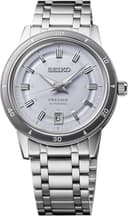
If you want one dress watch and no research: the Seiko Presage SRPL73, at about $446. It is the easiest watch here to wear — 39.5 mm across and 12.0 mm thick on a steel bracelet — it carries a full Seiko warranty and service network, and the textured silver-blue Style60’s dial reads as a far more expensive watch across a table. Honest cons: 5 bar only, box-shaped Hardlex rather than sapphire on a watch that lives beside shirt cuffs, and 4R35 accuracy that Seiko does not publish for this reference.
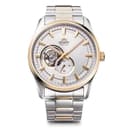
If you want the most documented watch for the least money: the Orient Stretto Semi-Skeleton, at about $330. Orient states caliber F6S22, 24 jewels, a daily rate of +25 to −15 seconds, over 40 hours of reserve, a sapphire front crystal, 5 bar, a 316L steel band and the full case geometry of 40.8 mm by 48.0 mm by 10.9 mm — the only complete sheet on this page, from a company that builds its own movements. Honest cons: 40.8 mm with a 48 mm lug span is not a small dress watch, and cutting the dial open costs contrast against the hands. If the open dial is the appeal rather than the specification, our open-heart roundup covers the single aperture version of the same idea.
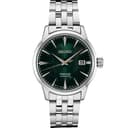
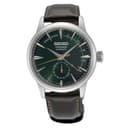
If the dial is the reason you are buying: the Seiko Presage SRPE15, at about $380, is usually the cheapest route to the lacquered Cocktail Time face, in a green that reads near-black indoors and vivid in daylight. Seiko publishes 40.5 mm, 11.8 mm thick, 23 jewels and about 41 hours — it is the thinnest Seiko here. Honest cons: green dials date faster than neutrals, the same 5 bar rating applies, and it is the same 4R35 movement as the cheaper references.
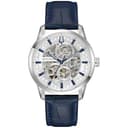
If you want a crystal that survives a decade: the Bulova Sutton 96A330, at about $438, is the only pick with an anti-reflective domed sapphire crystal, on a 40 mm case with 21 jewels and 42 published hours. Honest cons, and they are real: Bulova publishes no meter figure for water resistance at all, names no caliber — so there is no accuracy figure to hold it to — and the open dial with blue applied indices is not the blue-dial watch the photographs can imply. The 43 mm version of the same watch gets domed mineral, which makes this reference the better buy of the two; our skeleton roundup puts them side by side.
If you want something on the dial that actually does something: the Seiko Presage SSA459, at about $476, is the one watch here whose extra money buys a mechanical function rather than finishing. The 29-jewel 4R57 drives a power-reserve indicator and a date hand, so you can see how much winding is left without taking the watch off. Honest cons: 14.4 mm thick, which is chunky for a dress watch and shows under a cuff; it is on cow leather rather than a bracelet; and the water resistance is the same 5 bar as the cheaper Presages.
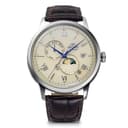
If you want a warm, old-fashioned dress watch: the Orient Bambino Sun & Moon RN-AK0803Y, at about $357, puts a day-and-night aperture under the domed crystal of the case that made Orient’s name with beginners. Honest cons, stated clearly: this is a day/night indicator, not a lunar moonphase — it tracks a 24-hour cycle, not the moon’s 29.5-day one — the crystal is domed box mineral, the rating is only 30 m, and at 41.5 mm the Bambino case wears larger than the number suggests. If a true lunar display is the goal, our moonphase roundup separates the watches that do it from the ones that imitate it.
And if this band is above where your budget actually sits, dress automatics under $300 is where Orient’s plain Bambino and a sapphire-crystal Miyota 9015 come into range, and dress automatics under $200 is the band where makers either name their movement or say nothing at all. Going the other way, automatics under $1,000 is where sapphire stops being a question on a dress watch.